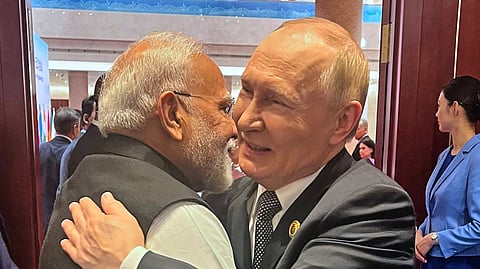

NEW DELHI: In a strong display of personal rapport and strategic alignment, Prime Minister Narendra Modi and Russian President Vladimir Putin held a bilateral meeting on Monday amid US pressure over India’s Russian oil imports and growing international calls for an end to the war in Ukraine, with Modi expressing support for recent peace efforts and urging all sides to move forward constructively.
The meeting took place on the sidelines of the Shanghai Cooperation Organisation (SCO) summit in Tianjin, where Modi and Putin walked hand-in-hand toward Chinese President Xi Jinping in a striking image of diplomacy in an increasingly polarised and ready-to-realign global order. Calling each other “dear friend,” Modi and Putin held their one-on-one conversation inside the Russian leader’s armoured Aurus limousine, a rare gesture reserved for chosen friends and trusted allies. “Even in the most difficult situations, India and Russia have always walked shoulder to shoulder,” Modi said, and added that close relations between the two countries are significant for global peace, stability and prosperity, reaffirming New Delhi’s commitment to the decades-old Special and Privileged Strategic Partnership.
Putin echoed the sentiment, highlighting a “friendly and trusting” foundation that would guide future cooperation. The Russian leader added, addressing Modi: "Dear Prime Minister, my dear friend, Russia and India have for decade’s maintained special relations of friendship and trust, which is the foundation for our future relationship." Putin said the India-Russia relations are “politically non-partisan and have the support of the majority of people in both countries.” The personal warmth and intent to step up the ties came amid rising tensions in India-U.S. relations, particularly over Washington’s tariff response to India’s purchases of discounted Russian crude. While the Biden administration had wanted India to purchase the Russian oil to stablise the global market, Donald Trump slapped additional tariffs on India raising alarms over strategic drift.
Despite the pressure, India and China remain the two largest buyers of Russian oil and there’s little sign of either country shifting course going by the indications from the Tianjin. Modi once again underlined India's stance on the Ukraine conflict.

“We welcome all recent efforts to bring peace to Ukraine and hope that all relevant sides will move forward constructively,” he said. Over the weekend, Modi reiterated similar sentiments in a call with Ukrainian President Volodymyr Zelenskyy, calling for a "durable and peaceful settlement."
In their talks, the two leaders discussed deepening cooperation across trade, energy, fertilisers, space, security, and culture. The Indian readout noted “sustained growth” in bilateral ties and confirmed plans for Putin’s upcoming visit to India later this year for the 23rd Annual Summit. Putin, in his remarks at the SCO summit following talks with both Xi and Modi, said that any lasting peace in Ukraine would require addressing NATO’s eastward expansion, signaling Moscow’s continued stance, seen as hardline by the West, even as Kremlin entertain diplomatic overtures from the US. With the US applying economic pressure and global power centres shifting, Modi's meeting with Putin sent a calibrated message of India pursuing a multipolar strategy, balancing ties with Russia, engaging with the West, and calling for lasting peace in Ukraine.