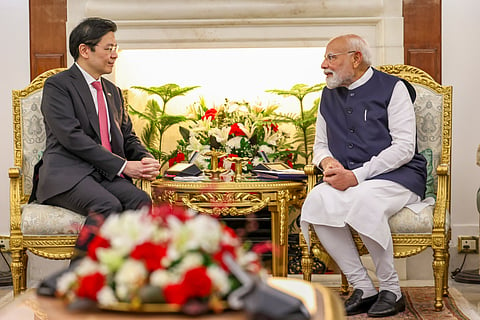

NEW DELHI: India and Singapore on Thursday unveiled a comprehensive economic roadmap aimed at deepening strategic cooperation across trade, civil nuclear energy, and defence ties, amid growing global trade uncertainties.
The announcement was made following wide-ranging talks between Prime Minister Narendra Modi and his Singaporean counterpart Lawrence Wong, who is on his maiden official visit to India. The leaders agreed to fast-track the review of the Comprehensive Economic Cooperation Agreement (CECA) and the ASEAN Trade in Goods Agreement (ATIGA) in a time-bound manner to accelerate bilateral trade and economic integration.
“This decision will accelerate bilateral trade,"” Modi said, as both leaders unveiled a renewed roadmap to deepen strategic and economic ties. The move comes amid rising global protectionism, particularly the tariff-heavy trade regime under President Donald Trump, which has prompted India to diversify its export markets and reinforce regional partnerships.
Wong, on his first official visit to India since assuming office, underscored the importance of the partnership in current times.
“In a world marked by uncertainty and turbulence, the partnership between India and Singapore becomes even more important,” he said.
Modi echoed this sentiment, saying that the India-Singapore relationship now spans advanced manufacturing, green shipping, skilling, civil nuclear cooperation, and urban water management.
“India-Singapore relations go far beyond diplomacy,” and pointed out that the partnership has expanded beyond traditional sectors,” he said, highlighting increasing participation by Indian states in building ties, and citing recent visits by the chief ministers of Odisha, Telangana, Assam, and Andhra Pradesh to Singapore.
Modi also noted that GIFT City in Gujarat has become a key connector between the Indian and Singaporean stock markets.
“Singapore remains a vital pillar of India’s Act East Policy and a partner in boosting ASEAN and Indo-Pacific stability,” he said, thanking Wong for Singapore’s solidarity after the recent terror attack in Pahalgam and its support in the global fight against terrorism.
“We believe that fighting against terrorism with unity is the duty of all countries which believe in humanity,” Modi added.
The two leaders also virtually inaugurated the second phase of the JNPort PSA Terminal (BMCT). The upgrade brings the total container handling capacity at India’s premier port to 4.8 million TEUs, reinforcing its position as a critical trade hub. JNPA now handles 54% of India’s total containerised cargo among major ports.
A number of agreements were signed during Wong’s visit, including a key MoU on digital asset innovation between the Reserve Bank of India and the Monetary Authority of Singapore.
Speaking to reporters later, P. Kumaran, Secretary (East) at the MEA, emphasised Singapore’s position as India’s largest FDI source in recent years.
“Over the last seven years, Singapore has averaged about $15 billion in FDI annually, with cumulative investments since 2000 standing at $170 billion,” he said.
With India’s growth trajectory intact despite global uncertainties, Singapore continues to view India as a long-term investment destination, Kumaran noted.
Civil nuclear cooperation also featured in talks, with both sides agreeing to explore collaboration on Small Modular Reactors (SMRs) and emerging technologies. Teams from both nations will be formed to take this forward.
On maritime security, India has expressed interest in joining the Malacca Straits Patrol, currently conducted by Malaysia, Indonesia, Thailand, and Singapore. Kumaran confirmed discussions are ongoing but no conclusion has been reached yet.
In civil aviation, Singapore is looking to invest in India’s MRO (Maintenance, Repair, and Overhaul) infrastructure.
“Singapore Airlines, which holds a 25% stake in Air India, is working closely with Tata Group to develop MRO capacity in India,” Kumaran said. The partnership could leverage India’s land availability to establish major MRO hubs.
While there was no direct discussion on the Trump administration’s tariff actions, officials confirmed that the talks addressed the broader context of global trade uncertainty.
“There’s a growing need to diversify trade and supply chains through FTAs and PTAs,” Kumaran said
