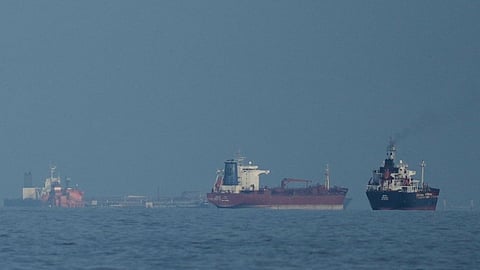

U.S. President Donald Trump and Iran’s foreign minister said Friday that the Strait of Hormuz is now fully open to commercial vessels, as a 10-day truce in Lebanon appeared to hold.
The truce offered a pause in fighting between Israel and the Hezbollah militant group and could clear one major obstacle to a deal between Iran and the United States and Israel to end weeks of devastating war. But it remained unclear whether whether the militant group would recognize a deal it did not play a role in negotiating and which will leave Israeli troops occupying a stretch of southern Lebanon.
In a social media post, Trump said Iran announced that the strait “is fully open and ready for full passage.”

Minutes earlier, Iranian Foreign Minister Abbas Araghchi posted on X that the passage for all commercial vessels through the strait “is declared completely open” in line with the ceasefire in Lebanon. He said it would stay open for the remaining period of the ceasefire.
It was not immediately clear what that meant for the US blockade of the strait, but Trump said the blockade would “remain in full force” until Iran reaches a deal with the US to end war.
World leaders welcome announcement
The leaders of France and the UK on Friday welcomed the announced reopening of the Strait of Hormuz but say it must become permanent.
President Emmanuel Macron and Prime Minister Keir Starmer say they will keep planning an international mission to restore maritime security, with a meeting of military planners in London next week.
Speaking after a gathering of some 50 countries, Macron said, “We all demand the full, immediate and unconditional reopening of the Strait of Hormuz by all parties.”
Starmer said the announcement by Iran and the US that the waterway is open must become “both lasting and a workable proposal”.
He said France and the UK will lead a multinational mission to safeguard shipping “as soon as conditions allow”.
Iranian media challenge announcement about Strait of Hormuz
Two Iranian semiofficial news agencies seemed to challenge Araghchi's announcement about the strait.
Considered close with Iran's powerful Revolutionary Guard, the Fars news agency issued a series of posts on X criticizing what it said was a lack of clarity over the decision to reopen the waterway and a “strange silence from the Supreme National Security Council and the negotiating team.”
Iran’s Supreme National Security Council has recently acted as the country's de facto top decision-making body, amid doubts over the status of the new supreme leader, Mojtaba Khamenei, who was reportedly wounded early in the war.
The Mehr news agency also said the decision to reopen the strait needed “clarification” and required the supreme leader’s approval.
Oil prices drop more than 10%, US stocks soar after announcement
Oil prices fell sharply on Friday, giving a major boost to global markets and raising hopes that inflationary pressures could ease in the coming months after Iran's announcement.
Benchmark U. crude dropped 10.8 per cent to $81.38 a barrel, while Brent crude, the international benchmark, fell 10.5 per cent to $88.96 a barrel. The decline marked one of the biggest single-day drops in oil prices in recent months.
Even after Friday’s plunge, however, both crude benchmarks remain above the roughly $70-a-barrel levels seen before the conflict in West Asia intensified. That suggests investors are still building some caution into prices amid fears that geopolitical tensions could flare up again.
The sharp decline in oil prices was welcomed by markets because cheaper crude can eventually lower the cost of fuel, transport and manufacturing. That can ease pressure not only on petrol and diesel prices, but also on food, airline tickets, shipping costs and consumer goods.
Wall Street reacted strongly to the move. The S&P 500 rose 1.3 per cent, while the Dow Jones Industrial Average climbed nearly 1,000 points. The Nasdaq Composite also gained 1.6 per cent.
Companies that are heavily dependent on fuel costs were among the biggest gainers. United Airlines surged 8.8 per cent, while cruise operators Norwegian Cruise Line and Royal Caribbean Group rose 7.8 per cent and 9.5 per cent respectively.
The fall in oil prices also raised hopes that inflation could cool more quickly, giving the Federal Reserve more room to cut interest rates later this year.
That optimism pushed down the yield on the 10-year US Treasury bond to 4.23 per cent from 4.32 per cent a day earlier. Lower bond yields generally translate into cheaper borrowing costs for households and businesses, including mortgages, auto loans and business credit.
Housing-related stocks also benefited. Lennar rose 5.7 per cent, while Builders FirstSource gained 7.1 per cent on expectations that lower interest rates could encourage more home purchases.