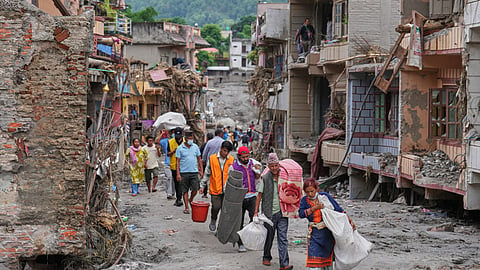

The death toll in Nepal’s devastating floods rose to 734 as rescue operations continued on Sunday, Day 5, with rescuers battling difficult terrain and rising waters to locate hundreds of people still missing.
The combined toll in Nepal and Tibet stood at 750, with at least 3,044 people unaccounted for, according to figures released by authorities on Sunday. In Nepal, 2,498 remain missing, including hundreds of foreigners, while Chinese authorities reported 16 deaths and 546 people missing in Tibet.
The floods struck the China-Nepal border region on Wednesday after a sudden glacial collapse sent a wall of water and debris through Himalayan valleys, sweeping away villages and damaging major infrastructure. More than 3,700 people have so far been rescued in Nepal.
In Nepal’s Rasuwa district, rescue teams continued efforts to reach workers believed to be trapped inside tunnels at hydropower projects. At the Trishuli 3A site, the Nepali Army successfully inserted a pipe into a tunnel and began sending air through a small opening. More than 100 workers are believed to be trapped across the Trishuli 3A and 3B sites. Rescue operations, however, were hampered by rain and rising river levels.
Rescuers were also working at the Upper Trishuli-1 Hydropower Project and the severely damaged Gyirong border crossing on the Chinese side. Nepal Army spokesperson Brig Gen Raja Ram Basnet said efforts would continue at the hydropower construction site, where thick mud has filled tunnels.
The scale of the disaster has left families desperately searching for missing relatives. At an army base in Bidur, relatives crowded around lists of rescued people pasted on walls, while in Kathmandu families gathered outside hospitals, checking notice boards and lists of injured people for any information.
In Nuwakot, one of the worst-hit districts, helicopters ferried relief supplies including clothes, noodles, crackers and rice, while returning with survivors. Many evacuees arrived with little more than the clothes they were wearing. Soldiers carried children and elderly survivors from the flood-hit areas.
The disaster has also severely affected Nepal’s hydropower sector and the region’s pilgrimage and trekking routes. Nepal’s disaster authority has listed 933 hydropower workers among those missing, while hundreds of foreigners, including trekkers and Hindu pilgrims travelling towards Mount Kailash, are also unaccounted for.
Rescue operations remain challenging because of the steep mountains and narrow gorges in the region. Nepal has sought specialised assistance in tunnel rescue, survivor-detection technology, forensic and DNA analysis, as well as equipment to store recovered bodies. An 11-member tunnel rescue reconnaissance team from India has already been deployed.
Authorities are also monitoring a newly formed lake in the Himalayas that had raised fears of another flood. Chinese officials said the lake had significantly reduced in size and was “essentially drained” after discharging naturally, easing concerns of an immediate further surge.
Nepal has received more than 57 metric tonnes of relief supplies from India, with additional assistance coming from China, Japan, Australia and other countries. The United States and Canada have each pledged $3.6 million in humanitarian aid, while the UK has offered $6.8 million.
The UN has released $2.5 million in emergency funding.
As search operations enter their fifth day, authorities remain focused on reaching those still missing and identifying the dead. Nepal’s Foreign Minister Shisir Khanal has warned that reconstruction costs could run into billions of dollars, underscoring the scale of the devastation.
