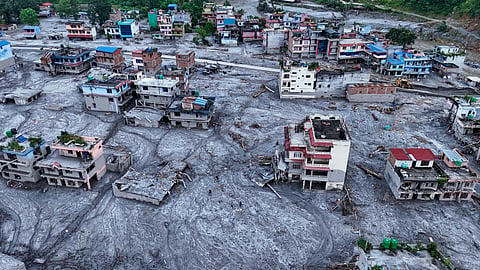

The death toll in Nepal's devastating flash floods climbed to 675 on Saturday as rescuers continued to recover bodies, while renewed rainfall and rising water levels heightened fears of further flooding in the Bhotekoshi River basin.
Nearly 2,400 people remained missing, including at least 320 foreign nationals, while more than 4,400 people have been rescued or evacuated so far as rescuers race against time to reach remote settlements cut off by the destruction of roads and bridges.
Officials further said that the rescued ones included at least 261 foreign tourists who went “out of contact”. Of them, 167 were Indians, 40 Chinese, eight Ukrainians, four each from Germany and Malta, three from the US, and the rest were from Turkiye, Portugal, Russia, Spain, Switzerland, Italy, Oman, Belgium and Bulgaria.
So far, 675 bodies of the Bhotekoshi flood victims have been recovered from eight districts, according to a statement by Nepal Police.
The rescuers have recovered 246 bodies from Chitawan, 165 from Nawalparasi East, 63 from Nawalparasi West and 57 from Gorkha, it said.
Similarly, 45 bodies were recovered from Dhading district, 51 from Nuwakot, 35 from Tanahu and 13 from Rasuwa district.
More than 15,000 security personnel have been mobilised for search and rescue operations, while helicopters have been making repeated sorties to evacuate stranded people and deliver relief supplies.
The disaster, believed to have been triggered by a collapse or avalanche of ice and rock in the Himalayan region near the Nepal-Tibet border, sent a massive torrent of water, mud and debris downstream through central Nepal on Wednesday, devastating towns and villages in several districts, sweeping away homes, vehicles, roads and bridges and damaging hydropower projects.
The Bhotekoshi River, which flows south from the Himalayan border region, became the main conduit for the floodwaters spreading downstream into central Nepal, causing the devastation.
Seven people were also reported dead on the Chinese side of the border, with more than 550 people reported missing, according to Chinese authorities.
Nepal Prime Minister Balendra Shah on Saturday said the government is with the flood-affected citizens of the country and its priority is to save the life of every citizen.
“It is the first priority of the state to save the life of each and every citizen through the mobilisation of all the state mechanism,” he said.
Nepal’s Foreign Minister Shisir Khanal said search and rescue teams, medical personnel and emergency responders were working together in the affected areas, while authorities were coordinating with families to identify missing people. Diplomats were also facilitating communication with families of missing foreign nationals.
Khanal said the government was monitoring the possibility of further flooding and that the affected region remained on “high alert”.
Renewed rain is adding to the difficulties, with emergency teams warning that weather and damaged infrastructure are making it harder to reach some of the worst-hit areas.
Some of the most severely affected locations can be reached only by helicopter after roads and bridges were swept away, while difficult terrain is further complicating rescue operations.
A new lake formed upstream of the disaster zone after the initial flooding, raising fears of another surge downstream. Chinese monitoring indicated that the lake had subsequently shrunk from its peak level, but Nepali authorities continued to closely monitor water levels and the possibility of further flooding.
In a breakthrough late Saturday, the Nepali army was able to insert a pipe into a tunnel at the Trishuli 3A hydroelectric site where workers are believed to be trapped.
"We have already started sending air through the small opening, and we will now begin excavation work and send the rescue team inside," Home Minister Sudan Gurung said in a statement.
More than 100 workers may still be alive and trapped inside such tunnels, with rescue efforts focused on the Trishuli 3A and 3B sites.
An 11-member Indian team which was sent to Nepal carried out on-site reconnaissance of hydropower tunnels in the flood-affected regions on Saturday. The specialised team later reached Trishuli in Nuwakot district to assist in efforts to rescue workers trapped in a tunnel belonging to a hydropower project.
Nepali security forces have rescued 191 workers and residents from hydropower projects across the affected corridor, but many more remain unaccounted for at several sites. The Indian tunnel-rescue specialists are expected to provide technical assistance for some of the most difficult operations.
Since Wednesday, India has dispatched 57.6 tonnes of relief material to flood-ravaged areas of Nepal.
Kathmandu on Saturday praised India's assistance, with Nepal’s Finance Minister Swarnim Wagle describing the Indian government and Prime Minister Narendra Modi as “exceptionally generous” and saying New Delhi had indicated it would provide generous assistance for reconstruction.
Wagle said the immediate priority was rescuing people stranded or trapped by the floods, followed by recovery and reconstruction, as Nepal begins to assess the enormous damage to infrastructure and communities.
Nepal’s National Disaster Risk Reduction and Management Authority had warned on Friday of the possibility of further flooding after water levels rose at the site of Wednesday’s disaster. Officials have continued to monitor the situation closely as intermittent rainfall raises the risk of disrupting rescue and relief operations.
Nepal's meteorology department on Saturday warned of fresh rainfall and thunderstorms in the country's flash flood-affected areas, threatening to disrupt ongoing rescue and relief operations amid the worsening crisis,
The Mugling-Kathmandu highway, a major road link connecting the capital with other parts of the country, resumed operations on Saturday after remaining closed since Wednesday because of flooding and landslide risks. Several other roads and highways in central Nepal remain obstructed or difficult to access.
The scale of the disaster was reflected not only in the devastation left behind but also in extraordinary accounts of survival.
In Timure, a town near the Nepal-Tibet border, survivors described scrambling up hillsides as a wall of water, mud and stones swept through the settlement, with houses disappearing within seconds.
The scenes left behind have been equally stark. Buildings in some settlements were buried beneath several feet of mud, vehicles were half-submerged and electricity poles lay uprooted amid the debris.
Families have been moving through mud and wreckage in search of possessions, while relatives outside hospitals scan lists of survivors and photographs of the dead for news of loved ones.
At hospitals and relief centres, anxious relatives continue to search through names and photographs, while rescuers dig through mud, scour riverbanks and fly into isolated areas in the hope of finding survivors.
Chinese Foreign Minister Wang Yi on Saturday spoke to his Nepalese counterpart Shisir Khanal to convey Beijing’s decision to provide emergency financial assistance and aid to Nepal to deal with Wednesday’s flash floods at the Tibet-Nepal border.
(With inputs from PTI)
