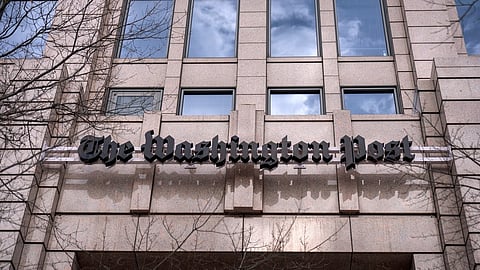

It is a grim day for journalism as The Washington Post on Wednesday confirmed sweeping layoffs, formally beginning a cost-cutting push that had loomed over the newsroom for weeks.
Internal warnings, union alerts and mounting public scrutiny had all pointed to this moment.
The cuts signal the most dramatic narrowing of the paper’s editorial vision since it was bought by former Amazon chief Jeff Bezos in 2013.
According to reports, nearly one-third of the Post’s workforce has now been laid off across the company.
Ishaan Tharoor, son of Congress MP and author Shashi Tharoor, and Pranshu Verma, the Post’s India bureau chief, were among those laid off.
"I’m heartbroken for our newsroom and especially for the peerless journalists who served the Post internationally — editors and correspondents who have been my friends and collaborators for almost 12 years. It’s been an honor to work with them," Tharoor wrote.
Verma also shared the news on X, writing, “Gutted for so many of my talented friends who are also gone. It was a privilege to work here the past four years.”
“Serving as the paper’s New Delhi bureau chief was an honor,” he added.
Though Bezos has not publicly addressed the job cuts, reports, however, say he has been pressing to return the publication to profitability, drawing criticism from journalists who have questioned both his strategy and intent.
In a column published earlier, senior fact-checker Glenn Kessler wrote, “Bezos is not trying to save The Washington Post. He’s trying to survive Donald Trump.”
Inside the newsroom of one of America’s most influential publications, the mood had been tense for weeks. On Wednesday morning, employees were instructed to “stay home today” as layoff notifications were sent out, confirming long-held fears.
An employee, quoted by The Guardian, captured the mood of the newsroom accurately: “It’s an absolute bloodbath.”
In an internal memo, Matt Murray, the executive editor of The Washington Post, told staff: “These moves include substantial newsroom reductions impacting nearly all news departments.”
The cuts are expected to fall heavily on the sports desk, the Books section and the Post’s flagship daily podcast, Post Reports.
The international desk is being significantly scaled back. However, Murray said about 12 international bureaus will continue, with a focus on national security coverage.
The Metro desk - long central to the paper’s self-description as “For and About Washington” - is being restructured and sharply downsized.
According to staff affected by the decision, Metro will shrink from more than 40 journalists to roughly a dozen.
Murray elaborated on the changes during a newsroom-wide Zoom call, describing the layoffs as a “strategic reset” driven by what he called “difficult and even disappointing realities”.
According to employees on the call, he stressed that the decisions were not a judgment on the quality of the journalism produced, but a response to financial pressures and audience behaviour that leadership believes can no longer be ignored.
He also acknowledged that the Post has struggled to reach “customers” in an increasingly crowded media marketplace.
“Today, The Washington Post is taking a number of actions across the company to secure our future,” Murray said, according to reports.
“We all recognise the actions we are taking today will be painful – most of all, of course, for those of you who are directly affected, but for everybody,” Murray told staffers on the call.
“I know that the reset is going to feel like a shock to the system and raise some questions for everybody,” he added.
In a follow-up email, reportedly from Murray, sent after the call, he said the company was taking steps “to place the publication on a stronger footing and better position us in this rapidly changing era of new technologies and evolving user habits”.
He added that meetings would be held with department leaders in the coming days to review how the changes would affect individual teams.
“Today's news is painful. These are difficult actions. We are proud of, and grateful for, the many valued colleagues whose talents and passion have contributed to the Post over many years,” the email read, adding that the decisions had been taken with a clarity of purpose.
Citing financial pressures, Murray said, “This restructure will help to secure our future in service of our journalistic mission and provide us stability moving forward.”
He argued that the upheaval at the Post was part of a wider shift across the media industry.
“We are far from alone in reevaluating our model or rethinking how we operate. The ecosystem of news and information, on- and off-platform, is changing radically. News consumers enjoy more variety, voices, platforms, and options than ever before. In just the last five years, multiple startups-and even individuals-have created meaningful products that draw attention and generate impact at low cost.”
“If we are to thrive, not just endure, we must reinvent our journalism and our business model with renewed ambition,” the email said.
Framing the layoffs as central to that effort, Murray wrote: “Today's actions are about addressing those questions, forcefully, to reinvent The Washington Post for this new era. This work is difficult, but it is essential. The Post is a necessary institution, and it must remain relevant.”
Seeking to underline the business case behind the cuts, Murray said the move was “about positioning ourselves to become more essential to people’s lives in what is becoming a more crowded, competitive and complicated media landscape”.
The former executive editor of the Post, Martin Baron, said: “This ranks among the darkest days in the history of one of the world’s greatest news organisations.”
The overhaul comes as the publication struggles with shrinking subscriptions, declining advertising income and an increasingly crowded digital news market.
At its peak, the paper crossed three million paying subscribers during the Trump-era surge in readership. That figure has since dropped sharply and is now “far below” its peak, according to reports.
Around a year ago, the Post laid off roughly four per cent of its workforce, though the newsroom was spared. This time, the newsroom itself is bearing the brunt.
The scale and nature of the cuts suggest a rethinking of the Post’s long-term direction. For decades, it combined strong local reporting in the Washington region with wide-ranging national and international coverage targeted at policymakers, diplomats and business leaders. That approach expanded significantly under former executive editor Marty Baron, when the paper invested heavily in investigative and accountability reporting during Trump’s first term, a period that also delivered record subscriber growth.
Former editors and current staff now say the Post appears to be narrowing its focus, reshaping itself as a publication centred more tightly on federal power, with greater emphasis on US politics, national security and government oversight.
The transition has not been smooth internally. Senior editors have told colleagues they were largely left out of discussions on how the restructuring would unfold.
Murray is also said to have resisted proposals for even steeper cuts, according to people aware of the deliberations.
Concerns about the paper’s finances were laid bare last year when publisher and chief executive Will Lewis told staff at a June 2024 meeting that the Post had lost USD 177 million over two years and that “not enough people” wanted to read its journalism.
Since that meeting, Lewis has not held another newsroom-wide town hall, even as the company introduced initiatives built around artificial intelligence, personalised news products and experimental teams. Those efforts have so far failed to stop losses that still run into tens of millions of USD annually.
The layoffs are part of a broader crisis across the US media industry. Traditional newspapers, digital-first outlets and television networks are all grappling with falling ad revenues and fragmented audiences.
The Los Angeles Times has announced repeated newsroom cuts in recent years, including a six per cent reduction in mid-2025. BuzzFeed News shut down in 2023. Vice Media filed for bankruptcy the same year. Business Insider has recently cut more than 20 per cent of its staff while pushing faster adoption of artificial intelligence.
In that climate, scrutiny of Jeff Bezos’s ownership of the Post has intensified again. When he bought the paper from the Graham family in 2013 for USD 250 million, Bezos framed the deal as a long-term civic commitment driven by innovation rather than short-term profit. He backed a rapid expansion, with the newsroom growing by about 85 per cent at its height.
Some former executives now argue that even after the latest cuts, a leaner Post could still dominate coverage of Washington, provided it is steered by a clear and consistent editorial vision.
Whether this “reset” restores financial stability or further erodes the paper’s standing will depend on what follows the cuts. For an institution that once shaped national debate on its own terms, the challenge now is not simply relevance, but survival in a rapidly changing world.
