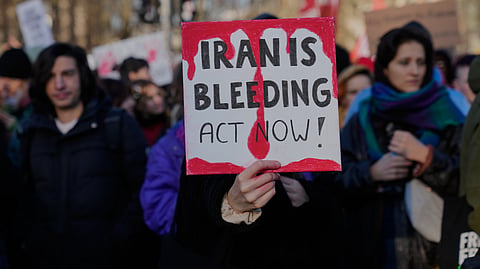

DUBAI: The toll in Iran's bloody crackdown on nationwide protests has reached at least 5,002 people killed, activists said Friday, warning many more were feared dead as the most comprehensive internet blackout in the country's history crossed the two-week mark.
The challenge in getting information out of Iran persists due to authorities cutting off access to the internet on Jan. 8, even as tensions rise between the United States and Iran as an American aircraft carrier group moves closer to the Middle East — a force U.S. President Donald Trump likened to an "armada" in comments to journalists late Thursday.
The U.S.-based Human Rights Activists News Agency offered the death toll, saying 4,716 were demonstrators, 203 were government-affiliated, 43 were children and 40 were civilians not taking part in the protests. It added that more than 26,800 people had been detained in a widening arrest campaign by authorities.
The group's figures have been accurate in previous unrest in Iran and rely on a network of activists in Iran to verify deaths. That death toll exceeds that of any other round of protest or unrest in Iran in decades, and recalls the chaos surrounding Iran's 1979 Islamic Revolution.
Iran's government offered its first death toll Wednesday, saying 3,117 people were killed. It added that 2,427 of the dead in the demonstrations that began Dec. 28 were civilians and security forces, with the rest being "terrorists". Iran's theocracy in the past has undercounted or not reported fatalities from unrest.
The Associated Press has been unable to independently assess the death toll, in part due to authorities cutting access to the internet and blocking international calls into the country. Iran also reportedly has limited journalists' ability locally to report on the aftermath, instead repeatedly airing claims on state television that refer to demonstrators as "rioters" motivated by America and Israel, without offering evidence to support the allegation.
The new toll comes as tensions remain high over Trump laying down two red lines over the protests — the killing of peaceful demonstrators and Tehran conducting mass executions. Iran's attorney general and others have called some of those being held "mohareb" — or "enemies of God." That charge carries the death penalty. It had been used along with others to carry out mass executions in 1988 that reportedly killed at least 5,000 people.
The U.S. military meanwhile has moved more military assets toward the Mideast, including the aircraft carrier USS Abraham Lincoln and associated warships traveling with it from the South China Sea.
A U.S. Navy official, who spoke on condition of anonymity to discuss military movements, said Thursday that the Lincoln strike group is currently in the Indian Ocean.
Trump said Thursday aboard Air Force One that the U.S. is moving the ships toward Iran "just in case" he wants to take action.
"We have a massive fleet heading in that direction and maybe we won't have to use it," Trump said.
Trump also mentioned the multiple rounds of talks American officials had with Iran over its nuclear program prior to Israel launching a 12-day war against the Islamic Republic in June, which saw U.S. warplanes bomb Iranian nuclear sites. He threatened Iran with military action that would make earlier U.S. strikes against its uranium enrichment sites "look like peanuts."
"They should have made a deal before we hit them," Trump added.
The United Kingdom's Defense Ministry separately said its joint Eurofighter Typhoon fighter jet squadron with Qatar, 12 Squadron, "deployed to the (Persian) Gulf for defensive purposes noting regional tensions."
