
MANILA: A clash in the South China Sea threatened to overshadow a meeting of Southeast Asian nations on Tuesday as the United States condemned "dangerous" Chinese actions in the contested waterway.
The US statement came minutes after Secretary of State Marco Rubio arrived in the Philippines, where the 11-member Association of Southeast Asian Nations (ASEAN) is expected to tackle issues including civil war-torn Myanmar's ongoing pariah status.
Before departing Washington on Monday, Rubio said he was open to the possibility of a sideline meeting with China's top diplomat Wang Yi, who will also be in Manila.
In an op-ed published Tuesday morning in the Philippines, Rubio touted Washington's commitment "to freedom of navigation in Southeast Asia" and the regional defensive umbrella it has provided.
"This freedom is by no means guaranteed. If these waters were to fall under the control of a power willing to use trade as a geopolitical weapon, both the United States and the ASEAN states would face serious new threats to their sovereignty, security, and economic future," he wrote, in a clear allusion to China.
Beijing claims sovereignty over almost the entire South China Sea, a vital global trade route, despite an international ruling that its claims have no legal basis.
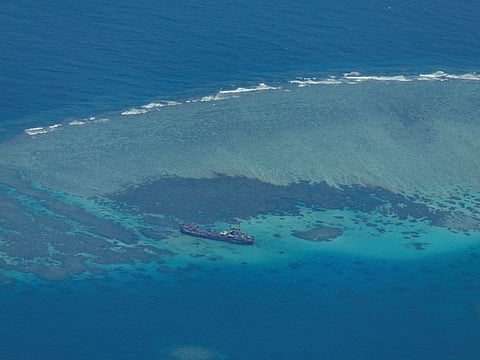
On Monday, Philippine and Chinese sailors clashed at the Second Thomas Shoal in the South China Sea in what was the first serious seaborne encounter in months.
Manila said China Coast Guard personnel had assaulted Filipino sailors near a beached vessel that serves as a garrison on the disputed shoal.
Beijing said the Philippines instigated the incident by sending men in small rubber boats to approach their vessel.
The clash casts further doubt on hopes for a long-sought Code of Conduct between ASEAN and China for the waterway, a quest analysts have warned is unlikely to result in a document with teeth.
The resumption of hostilities in another strategic waterway, the Strait of Hormuz, also looms large this week, as the rekindled war with Iran is placing traditional American allies under economic strain.
The import-dependent Philippines declared a national energy emergency in March and has been forced to cast an ever-wider net for fuel, including purchases of oil from Russia, whose Foreign Minister Sergei Lavrov will arrive Tuesday in Manila.
The week is expected to see renewed efforts towards regional energy security, including the ongoing push for ratification of the bloc's Framework Agreement on Petroleum Security fuel-sharing scheme.
- 'Back into the fold' -
No issue facing Southeast Asia's foreign ministers has been more fraught than how to reintegrate Myanmar, a member state formally excluded from such summits since its military junta seized power in 2021.
In May, ASEAN leaders emerged from an emotional meeting in Cebu that ended with Philippine President Ferdinand Marcos calling for a "fine-tuning" of the bloc's long-stalled five-point plan to end Myanmar's bloody civil war.
Thailand, which shares a long border with Myanmar and hosts millions of its refugees, has led the push for full reintegration.
Last week, days after Myanmar's foreign minister met with a group of ASEAN counterparts in Bangkok, Thai Foreign Minister Sihasak Phuangketkeow told AFP that leader Min Aung Hlaing would visit in August.
"It's best to bring Myanmar back into the fold," Sihasak said.
"We believe that after five years we need to talk, we need to listen, and they need to explain," he said.
But others in the bloc have bemoaned the lack of progress on a long-stalled five-point peace plan that has formed the basis of engagement.
Malaysian Foreign Minister Mohamad Hasan told reporters in May that his country remained opposed to high-level talks while "oppression is still taking place".
