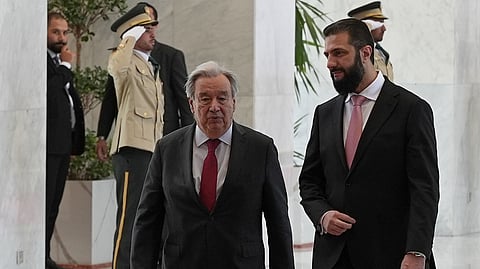

DAMASCUS: UN chief Antonio Guterres on Saturday called for an end to Israeli violations in Syria and urged international support for the country's transition on his first visit under the new authorities following years of civil war.
Foreign Minister Asaad al-Shaibani called for the withdrawal of Israeli forces from a UN-patrolled buffer zone on the Israeli-occupied Golan Heights, where they deployed in 2024 after the ouster of longtime ruler Bashar al-Assad.
Guterres is the first UN chief to visit Syria since his predecessor Ban Ki-moon in 2009, two years before the start of Syria's war, which went on to kill more than half a million people before the new Islamist authorities took power.
"We underscore the importance of fully respecting Syria's sovereignty, independence, unity, and territorial integrity," Guterres told a press conference.
"Violations of Syria's sovereignty and territorial integrity are unacceptable and must cease. What is happening in the region around the Golan Heights is totally unacceptable," he said, adding: "I'd like to remind the international community that the Golan Heights are Syrian territory."
After Assad's overthrow, Israel sent troops into the UN-patrolled buffer zone that separated Israeli and Syrian forces on the Golan for decades, and has carried out strikes and repeated incursions deeper into Syrian territory.
Israeli officials have said they intend to keep forces in a "security zone" in southern Syria.
'Pivotal' moment
Shaibani said "the continuation of Israeli military actions and the unlawful occupation of our land beyond the 1974 line is a direct threat to the security of the region".
"We renew our demand for a firm UN position that pushes for an immediate and unconditional withdrawal," he added.
Guterres, on what he called a solidarity visit, said the UN stood with Syria at a "pivotal" moment.
"We are ready to support your political transition, including your efforts to ensure transitional justice, draft a permanent constitution, and hold free and fair elections," Guterres said.
Syria's recovery is a humanitarian imperative and "an investment in development, in peace and regional stability", he said.
"Syria is today the pillar of stability of the Middle East," Guterres added, as the Iran-US war roils the region.
Shaibani called the visit "a clear declaration of Syria's shift to the position of an active partner in the United Nations, and the beginning of a new phase based on close cooperation to achieve a full national recovery".
Since President Ahmed al-Sharaa took power, the international community has urged the new Islamist authorities to establish a governance system that includes all components of Syria's multi-ethnic, multi-confessional society, particularly after sectarian bloodshed last year.
A statement from Sharaa's office said his meeting with the UN chief addressed strengthening cooperation between Syria and the UN "in the humanitarian and development fields".
Old City visit
It also addressed "supporting efforts towards early recovery and reconstruction and emphasising respect for Syria's sovereignty, unity and territorial integrity", the statement said.
State media said Guterres earlier visited Damascus's Old City, with images showing him at the famed Umayyad Mosque.
On the trip, Guterres is also to meet representatives of Syrian civil society and non-governmental organisations supporting women's issues, and to visit the UN peacekeeping force in the Golan.
Israel captured most of the Golan from Syria in the 1967 Arab-Israeli War and later annexed the areas under its control, in a move not recognised by most of the international community.
Despite tensions between the neighbours, Israel and Syria's new authorities have held several rounds of direct talks and have agreed to establish an intelligence-sharing mechanism.
Syria's war shattered the country's infrastructure and pushed millions of people to flee internally and abroad.
"The international community must help create conditions for economic recovery, assist in the restoration of essential services and infrastructure, expand opportunities for livelihoods and employment, and help enable the safe, voluntary and dignified return of refugees and displaced people," Guterres said.
Since Assad's ousting, some 1.9 million internally displaced people and 1.7 million refugees have returned, according to the UN, while around 5.5 million people remain displaced inside the country and another six million overseas.
An estimated 15.6 million people require humanitarian assistance.
