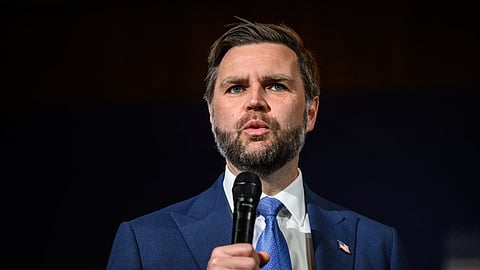

US Vice President JD Vance on Sunday described ongoing US-Iran negotiations in Switzerland as "historic", saying President Donald Trump remains committed to achieving a comprehensive regional ceasefire and pursuing a diplomatic reset with Tehran to help end the broader West Asia conflict.
The negotiations, being held at the luxury Burgenstock resort overlooking Lake Lucerne, mark the first direct technical-level engagement between the two sides under a framework established by a 14-point Memorandum of Understanding (MoU) agreed on June 17 by both the sides.
Leading the US delegation are Vance, special envoy Steve Witkoff and senior adviser Jared Kushner, while Iran is represented by Foreign Minister Abbas Araghchi and parliamentary speaker Mohammad Bagher Ghalibaf, alongside senior officials from the country's central bank and oil ministry. The talks are being mediated by Pakistan and Qatar.
Addressing reporters at the start of the discussions, Vance framed the meeting as a potentially transformative moment for the region.
"This is a historic meeting," he said. "The question before us now is how much more can we accomplish together? Can we turn over a new leaf? Can we change relations in the Middle East permanently? Or do we go back to doing things the old way, which is not our preference, but it's certainly very much something that can happen."
Vance said Trump had instructed the US team to pursue a fundamental reset in relations with Iran if Tehran demonstrates a willingness to abandon activities that Washington views as destabilising.
"What President Trump has asked us to do is turn over a new leaf to transform our relationship with the people of Iran," Vance said.
"If Iran's leadership is willing to give up being a driver of regional instability, if they are willing to give up nuclear weapons ambitions for the long term, then the United States is willing to fundamentally transform our relationship with that country."
He added that the administration's objective extends beyond a temporary cessation of hostilities.
"Trump is committed to seeing a full regional ceasefire," Vance said, acknowledging that enforcing such arrangements can be challenging. "These kinds of ceasefires are always a little bit messy."
Highlighting recent developments on the Lebanese front, he noted, "We've seen great progress over the last couple of days in ensuring the ceasefire in Lebanon holds."
The Vice President also expressed optimism about the ongoing negotiations, saying, "We have made great progress in the last few hours," and described diplomacy as the preferred path toward long-term regional stability.
"Iran has been a driver of regional instability," he said. "What we're trying to accomplish is, through diplomacy, to work together to transform the Middle East."
"The question is whether we can change relations in the Middle East permanently," he added, crediting Trump with giving negotiators broad authority to seek comprehensive solutions. "Trump empowered us to find a diplomatic solution to a host of issues."
Despite the conciliatory tone struck by Vance in Switzerland, Trump issued a stark warning to Tehran during the talks. In a post on Truth Social, the US president demanded that Iran rein in Hezbollah's activities in Lebanon.
"If they don't, we'll hit Iran very hard again, just like we did last week, only harder!!!" Trump wrote.
The negotiating room reflected the mediators' central role in the process. AFP journalists at the venue reported that the table was arranged in a U-shape, with the United States and Qatar seated on one side and Iran and Pakistan on the other. Representatives from Pakistan and Qatar also occupied seats at the head of the table.
Pakistan Prime Minister Shehbaz Sharif and Qatar Prime Minister Mohammed bin Abdulrahman Al Thani opened the proceedings with remarks emphasising the importance of diplomacy.
"I think we will have wonderful discussions which will lead to, hopefully, very productive results in times to come," Sharif said. "Hopefully when we go back to our homes we'll have some wonderful paper in our hand which will promote peace, progress and prosperity around the globe."
The Iranian delegation did not address reporters during the opening session, and Araghchi did not join Vance and the mediators for a joint photograph.
The talks were originally scheduled to begin on Friday but were delayed by renewed exchanges of fire involving Israel and Lebanon, raising concerns over the fragile diplomatic timeline.
A key focus of the negotiations is the restoration of long-term regional stability and the protection of critical global energy routes.
The June 17 MoU paved the way for the reopening of the Strait of Hormuz, a strategic maritime corridor through which nearly one-fifth of global energy supplies normally pass.
However, uncertainty remains over the status of the waterway. Tehran claimed on Saturday that it had once again shut the Strait following an Israeli strike in Lebanon, while US officials insisted that the route remains open.
Concluding his remarks, Vance described the talks as an unprecedented opportunity for engagement between the two countries.
"The technical negotiations may not solve every disagreement, but they will allow us to sit together as teams for the first time in history," he said.
The negotiations are expected to continue over the coming days as both sides work within a 60-day window established under the MoU to address security, economic and diplomatic issues that have long defined one of the world's most complex geopolitical rivalries.
(With inputs from AFP, ANI)
