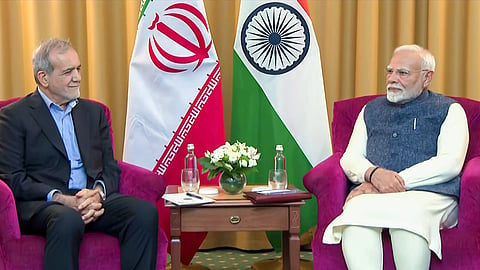

NEW DELHI: Iranian President Masoud Pezeshkian has invited PM Narendra Modi to attend the state funeral of Supreme Leader Ayatollah Ali Khamenei, with ceremonies set to be held across multiple cities between July 4 and July 9. However, New Delhi is yet to decide the level of representation it will send for the event, sources said.
The formal invitation was conveyed to the External Affairs Ministry on Tuesday through the Iranian Embassy in New Delhi, diplomatic sources said. Khamenei’s funeral ceremonies will begin in Tehran on July 4, followed by observances in the holy city of Qom on July 7, before concluding with his burial in his hometown of Mashhad on July 9.
Khamenei, 86, was killed in a joint US-Israeli airstrike in February amid the conflict between Iran, the US and Israel. His burial had initially been planned for March but was postponed as military operations continued and regional tensions remained high. The rescheduled funeral is expected to draw leaders from many parts of the world.
PM Modi is among several global leaders who have been invited by President Pezeshkian. Other invitees include leaders from China, Russia, Qatar, France and Pakistan.
Khamenei led Iran for more than three decades after succeeding Ayatollah Ruhollah Khomeini in 1989. While Khomeini was the principal architect of the 1979 Islamic Revolution that overthrew the Pahlavi monarchy, Khamenei played a central role in consolidating the Islamic Republic’s political, military and security institutions. During his tenure, Iran expanded the influence of its military and paramilitary networks across the region and navigated multiple confrontations with Western powers.
Attention has increasingly turned to Khamenei’s son, Mojtaba Khamenei, who is widely viewed as a key figure within Iran’s leadership structure. Although he has largely remained out of public view since the conflict began, US Secretary of State Marco Rubio said earlier this month that Mojtaba seemed to be playing a more active role as negotiations between Tehran and Washington continue following an April 8 truce.
India and Iran maintain longstanding civilisational and strategic ties, with cooperation centred on connectivity, energy and regional trade. Modi last visited Iran in 2016, when he met Khamenei and then President Hassan Rouhani and signed the trilateral pact on the development of the strategically important Chabahar Port.
