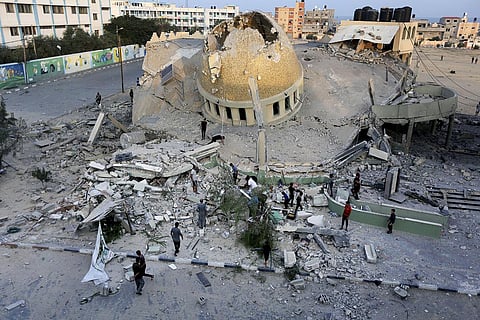

As the Middle East crisis deepens, the Iran–Israel conflict has escalated into a full-fledged war, with the United States now directly involved in the theatre. Washington’s entry follows attacks on its military bases in the Arab region, but its broader military actions alongside Israel suggest a wider strategic objective of weakening Iran’s leadership and curbing its regional influence. The expanding scope of engagement has significantly heightened tensions and raised fears of a deeper regional destabilisation.
Several European nations and key Gulf countries are increasingly aligning with Washington and Tel Aviv, while Iran appears to be drawing indirect support from Russia and China, further complicating the geopolitical landscape. With oil prices moving sharply upward, the conflict now carries the potential to trigger wider economic disruption across the globe.
Against this backdrop, it is important to revisit the historical trajectory of Iran–Israel relations — how two once-close allies became bitter adversaries, with consequences that are reverberating worldwide today.
In the early years after the founding of the State of Israel in 1948, Iran under the Pahlavi monarchy maintained a pragmatic relationship with Tel Aviv. Iran became one of the very first Muslim-majority states to recognise Israel, and the two countries quietly cooperated on diplomatic, economic and security matters. Israel saw Iran as a non-Arab partner in a hostile region and a useful counterbalance to Arab nationalism and Soviet influence. Iran supplied oil that helped Israel circumvent regional boycotts and welcomed Israeli technical assistance in agriculture, military training and intelligence sharing. During the Cold War, their mutual alignment with Western powers and shared concerns over regional threats further solidified this tacit partnership.
This period of cooperation ended abruptly with the 1979 Islamic Revolution in Iran. The revolution replaced the pro-Western Shah Mohammad Reza Pahalvi with an Islamic Republic under Ayatollah Ruhollah Khomeini, fundamentally altering Iran’s worldview and foreign policy. Khomeini’s new regime rejected the Shah’s close relations with Israel and denounced the Jewish state as an illegitimate occupier of Palestinian lands. The Islamic Republic adopted a revolutionary ideology that framed support for the Palestinian cause as a moral imperative and positioned itself as a champion of anti-Zionist resistance in the Arab and Muslim world. Iran’s leadership began using deliberately hostile rhetoric, branding Israel as one of the regime’s principal enemies and casting the US as “the Great Satan”. As part of cultivating its revolutionary identity and appealing to broader regional constituencies, Tehran ended all official ties with Israel.
From the 1980s onward, this ideological break evolved into a strategic rivalry. Iran began to invest heavily in proxy networks and militant groups that opposed Israel’s existence and challenged its security. Iran provided political, financial and military support to Hezbollah in Lebanon, and later to Palestinian groups such as Hamas and other factions that engaged in armed conflict with Israel. These proxy actors operated at the fringes of state control, but Tehran’s backing made them potent instruments of influence against Israel. Israel, in turn, viewed Iran’s nuclear ambitions with growing alarm from the 1990s onward, regarding a potential Iranian nuclear capability as an existential threat that could embolden Tehran’s hostile posture.
Over succeeding decades, the conflict deepened into a shadow war marked by covert operations, assassinations of nuclear scientists and military figures, cyber attacks, sabotage of infrastructure and repeated confrontations in theatres like Syria and Lebanon. Iran’s expanding influence in Iraq, Syria and Yemen, often through allied militias, heightened Israeli fears of encirclement and led to frequent Israeli strikes aimed at disrupting Tehran’s supply lines and weapons transfers. Episodes of direct confrontation further crystallised the animosity. In 2024, direct Iranian missile and drone strikes on Israeli territory in response to an Israeli attack on a consulate building marked a dramatic escalation, breaking longstanding norms of indirect proxy engagements. By the mid-2020s, open military actions and deep-rooted hostility had overtaken the once pragmatic relationship.
The evolution of Iran–Israel relations underscores how swiftly geopolitical dynamics can shift when ideological revolution replaces realpolitik cooperation, and how long-standing grievances, regional power competition, differing security perceptions and competing national narratives can drive former partners into entrenched rivalry and outright enmity.
Israel strike sparks direct US–Iran confrontation
Tensions between Iran and the US have intensified dramatically in recent weeks, closely intertwined with the expanding confrontation between Iran and Israel. What had long been a shadow conflict marked by sanctions, cyber operations and proxy engagements has evolved into a far more direct and volatile phase. The latest escalation followed coordinated military strikes by the US and Israel on targets inside Iran, described by Washington and Tel Aviv as necessary to curb perceived threats linked to Iran’s missile infrastructure and broader regional activities. The strikes signaled a significant shift, moving beyond indirect containment toward overt military action against Iranian assets.
Tehran responded swiftly and forcefully, framing the attacks as acts of aggression and a violation of its sovereignty. Iranian forces launched missile and drone operations targeting Israeli territory and facilities associated with US forces in parts of the Gulf region. Several Gulf states hosting American military installations found themselves on heightened alert as air defense systems were activated to intercept incoming projectiles. The retaliatory strikes underscored Iran’s readiness to broaden the geographic scope of confrontation rather than confining its response solely to Israeli targets.
The US, for its part, reinforced its military posture in the region, deploying additional defensive assets and warning of further action should American personnel or infrastructure come under sustained threat. Washington has maintained that its involvement is tied to protecting its forces and supporting Israel’s security, while also attempting to prevent the conflict from spiraling into a full-scale regional war. However, the cycle of action and counteraction has increased the risk of miscalculation, with each side signaling resolve while leaving limited room for de-escalation.
The recent exchanges highlight how deeply the US–Iran rivalry is embedded within the broader Israel–Iran conflict. For years, friction between Washington and Tehran centered on sanctions, nuclear negotiations and proxy confrontations in countries such as Iraq and Syria. Now, the alignment of US military operations with Israeli objectives has drawn the two adversaries into more direct confrontation. The conflict has raised concerns across global markets and diplomatic circles, as any sustained escalation could disrupt energy supplies, destabilise allied governments in the region and redraw strategic equations in West Asia.
While both sides have stopped short of declaring open war, the intensity and visibility of the recent strikes mark one of the most serious phases of US–Iran tension in decades. The situation remains fluid, with diplomatic channels reportedly active behind the scenes, but the prevailing atmosphere is one of heightened uncertainty. The coming days will likely determine whether the current escalation settles back into deterrence and proxy rivalry or expands into a broader and more destabilising regional conflict.