
BEIRUT: Lebanon's government has decided on an "immediate ban" of Iran-backed Hezbollah's military and security activity, Prime Minister Nawaf Salam said Monday, in an unprecedented move as Israel retaliated to rocket fire.
Hezbollah is represented in both the government and parliament and the move came hours after the party announced it had launched rockets and drones towards Israel early Monday, to avenge the killing of Iranian supreme leader Ali Khamenei in US-Israeli attacks Saturday.
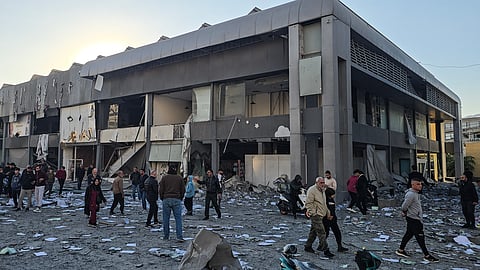
Israel began bombarding Beirut's southern suburbs and dozens of villages in south Lebanon, vowing to make the group pay a "heavy price" and killing at least 31 people and wounding at least 149 according to the Lebanese health ministry.
After an emergency cabinet meeting, Salam said: "The Lebanese state declares its absolute and unequivocal rejection of any military or security actions launched from Lebanese territory outside the framework of its legitimate institutions.
"This necessitates the immediate prohibition of all of Hezbollah's security and military activities, considering them to be outside the law, and obliging it to hand over its weapons".
On Monday, Salam ordered the military and security agencies to take "immediate measures" to implement the cabinet decision and prevent "any military operation or the launching of missiles or drones from Lebanese territory".
Justice Minister Adel Nassar announced in a post on X that the judicial authorities have tasked "security agencies with immediately arresting those who launched the rockets and their instigators".
A source close to the Lebanese government reported that two ministers from the Amal Movement, Hezbollah's fellow Shiite party and key ally, and one minister from the group itself approved the cabinet's decision.
The group has not issued any comment since claiming responsibility for the attack on Israel.
Renewed strikes
Israel renewed its strikes on Beirut's southern suburbs on Monday afternoon and hit several buildings belonging to Al-Qard al-Hassan, a Hezbollah-linked financial firm sanctioned by Washington, in several parts of the country, particularly the south.
They came after the Israeli military had issued evacuation warnings for several towns in the south and east and the capital's southern suburbs.
The US Embassy in Lebanon renewed its call for citizens to leave Lebanon immediately.
Lebanon's education ministry announced the closure of schools, universities and educational institutions in the country on Tuesday, due to "security conditions".
The authorities in Beirut have repeatedly said they do not wish to involve their country in the outbreak of conflict in the region, which started after a massive US-Israeli attack on Iran.
Beirut had decided last August to gradually disarm Hezbollah, following a year-long war fought with Israel that ended in a November 2024 ceasefire.
But the agreement did not stop Israel from continuing to strike targets it said were linked to Hezbollah, which it accused of trying to rearm.
The truce is monitored by a committee bringing together Lebanon, Israel, the United States, France and UN peacekeepers.
Salam on Monday called on the countries guaranteeing the ceasefire -- the United States and France -- to "obtain a clear and final commitment from the Israeli side to cease all attacks on the entirety of Lebanese territory".
He announced the government's "full readiness to resume negotiations" with Israel, "with civilian participation and under international auspices".
