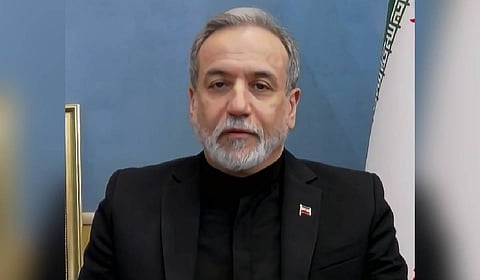

Iran's foreign minister said Sunday that the Iranian people, not Donald Trump, will elect their new leader and demanded that the US president apologize for starting the war with Iran.
"We allow nobody to interfere in our domestic affairs. This is up to the Iranian people to elect their new leader," Foreign Minister Abbas Araghchi told NBC's "Meet the Press".
Trump on Sunday reiterated his demand to have a say in picking Iran's next supreme leader after Ali Khamenei died in the opening salvos of the US-Israeli attack that began nine days ago.
"He’s going to have to get approval from us," Trump president told ABC News. "If he doesn’t get approval from us he’s not going to last long."
Araghchi would not be drawn on who the successor would be. Iranian state media reported Sunday that the clerical body responsible for doing that had voted and that a name would be announced soon.
Some clerics suggested Khamenei's son, Mojtaba Khamenei, would be chosen. Trump has previously rejected that possibility.
"We have to wait for the Assembly of Experts to convene and vote for the new supreme leader, and the one who is elected by them," Araghchi told NBC.
Trump told ABC he was open to a successor with ties to the Iranian government in power before the 1979 Islamic revolution, adding, "There are numerous people that could qualify."
In addition to rejecting the idea of the US president guiding the Iranian succession, Araghchi said Trump "should apologize to people of the region and the Iranian people for the killings and destruction they have done against us."
He defended Iranian attacks that have hit Gulf neighbors during the war, saying those strikes were aimed at US bases in the region as Iranian missiles were unable to reach the United States.
"It is Americans who started this war against us, attacking us, and we are defending ourselves. So it is obvious that our missiles cannot reach the US soil," Araghchi said.
"What we can do is to attack American bases and American installations around us, which are unfortunately in the soil of our, you know, neighbor countries."
Trump has asserted that Iranian missiles could "soon" be able to strike the United States, although a US intelligence assessment as recently as 2025 stated Tehran did not have intercontinental ballistic missiles, and that it could take until 2035 for it to develop 60 such weapons.
