
LONDON: Six major international powers, including Britain, France, Germany and Japan, said on Thursday they were ready "to contribute to appropriate efforts to ensure safe passage through the Strait of Hormuz."
"We welcome the commitment of nations who are engaging in preparatory planning" the grouping -- which also includes Italy and the Netherlands -- said in a joint statement, as they condemned "in the strongest terms recent attacks by Iran on unarmed commercial vessels in the Gulf."
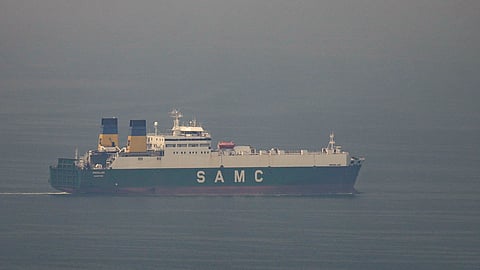
The declaration came as an effective Iranian blockade of the strait has paralysed commercial shipping through the crucial maritime chokepoint, which in peacetime sees a fifth of global crude oil and liquefied natural gas pass through it.
The war, which erupted on February 28 when the US and Israel began bombing Iran, has led Tehran to retaliate with strikes across the Gulf region, with 23 commercial vessels, including 10 tankers, reporting having been attacked or incidents.
The situation has left around 20,000 seafarers stranded on approximately 3,200 vessels west of the strait, according to the International Maritime Organization.
"We express our deep concern about the escalating conflict," the allies' joint statement said. "We call on Iran to cease immediately its threats, laying of mines, drone and missile attacks and other attempts to block the Strait to commercial shipping," it added.
"Freedom of navigation is a fundamental principle of international law, including under the United Nations Convention on the Law of the Sea. The effects of Iran's actions will be felt by people in all parts of the world, especially the most vulnerable."
US President Donald Trump has urged other world powers, and NATO, to help reopen the Hormuz Strait to commercial shipping, but they have rebuffed his call in the short-term while insisting they were open to discussions and planning.
"The level of threat is such that I don't see many nations being willing to put warships into the middle of that threat right now," a UK defence official told reporters at a briefing Wednesday. "We're working closely with allies and partners in terms of what we might be able to do and what we can offer, as and when the situation allows," he added.
The defence official noted London has sent a "small number" of additional military "planners" to US Central Command (CENTCOM) to "help with the planning and option development for... whatever comes next in the Strait of Hormuz might look like."
