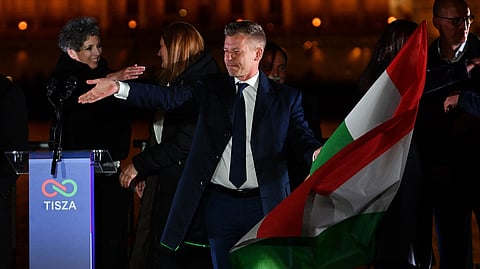

BUDAPEST: A few years ago, Peter Magyar applauded nationalist Viktor Orban from a front-row seat -- now, he is poised to take his place as prime minister after a landslide electoral victory.
"Together, we ousted the Orban regime, we liberated Hungary, we reclaimed our homeland," the 45-year-old former government insider, who is to be sworn in on Saturday, told a jubilant crowd during the election night last month.
European leaders hailed what they saw as a break with Orban's hostile approach to the European Union during his 16-year rule.
A skilful communicator -- on social media but also on the campaign trail -- pro-EU conservative Magyar has promised "regime change", vowing to dismantle "brick by brick" Orban's system.
In just two years, Magyar turned his Tisza party into a nationwide movement, pledging to curb graft and fix public services.
"In a way, Magyar is like Orban 20 years ago without all the baggage, the corruption and the mistakes made in power," Andrzej Sadecki, lead analyst at the Warsaw-based Centre for Eastern Studies (OSW), told AFP.
'Courageous'
Born into a family of prominent conservatives, Magyar was fascinated with politics from an early age.
During his university years studying law, he befriended Gergely Gulyas -- Orban's long-time chief of staff and current parliamentary leader of his Fidesz party -- and met Judit Varga, whom he later married and who became justice minister under Orban.
After a stint in Brussels, where Varga worked as an advisor to Hungarian MEPs and Magyar served as a diplomat dealing with EU matters, the family moved back to Hungary in 2018.
Magyar -- who has described himself as the "eternal opposition" from within -- then headed the state's student loan provider and sat on the board of several other state companies.
Magyar and Varga, who have three children, divorced in 2023.
While largely unknown to the public, Magyar shot to prominence during anti-government protests in early 2024 over the pardoning of a convicted child abuser's accomplice.
Asked at the time about the prospect of running for political office, Magyar brushed it off as a "bad (idea), even a joke" -- but weeks later he organised his first rally, attracting tens of thousands.
Magyar quickly became seen as "courageous, action-orientated and willing to take personal risks", Veronika Kovesdi, a media expert at Budapest-based ELTE university, told AFP.
As his popularity skyrocketed, Magyar faced a "tsunami of hatred and lies" as he put it, ridiculing some claims and denying others, including domestic abuse accusations from Varga.
'Balancing act'
Magyar's "reformist drive will drive his policies early on", according to analyst Sadecki.
Since his election victory, Magyar has already made a trip to Brussels to discuss unlocking billions of euros in EU funds earmarked for Hungary.
He has vowed to make the country a reliable EU member, publicly calling Russia -- with whom Orban fostered close ties -- a "security risk", but signalling he is ready for pragmatic cooperation with Moscow.
Like Orban however, Magyar also rejects sending arms to Ukraine and opposes the country's quick EU integration, though he does not share his predecessor's hostile rhetoric towards Kyiv.
He has even stricter anti-immigration views than Orban, pledging he would end the government's guest worker programme.
"His own instincts are more centre-right conservative, but I expect that he will try a balancing act to please his diverse electorate, giving some minor concessions to the more left-liberal voters," Sadecki said.
Magyar long avoided taking a clear stance on LGBTQ rights, but in his victory speech he said Hungary has decided it wants to be a country where "no one is stigmatised for loving differently or in a different way than the majority".
Occasionally, he has had heated arguments with the media, lambasting outlets for "misplacing" their focus.
