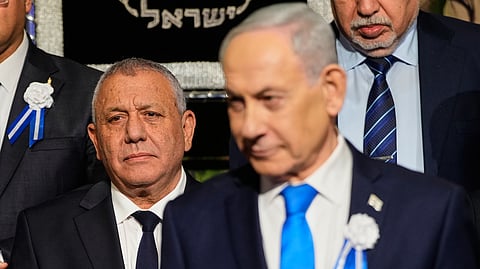

JERUSALEM: Gadi Eisenkot, who is trying to form the next Israeli government, on Friday accused the party of caretaker Prime Minister Benjamin Netanyahu of stalling coalition talks in a bid to bring about new elections.
Eisenkot's centrist Yashar party has in recent days agreed coalition deals with two allied parties, but the route to a parliamentary majority is still far from certain.
After the October election failed to deliver a clear majority for either bloc, Yashar has also held talks with Netanyahu's right-wing Likud party over the possibility of forming a national unity government involving both parties.
But no breakthroughs on that front have ostensibly been reached.
"Likud, for its part, was unwilling to compromise and, over two weeks, refused to put a single concrete proposal on the table," Eisenkot said in a statement on Friday.
"Their conduct points to an effort to run down the clock until the mandate expires, split the Change bloc and drag Israel into another election under the outgoing government," he added.
Eisenkot has until December 6 -- a deadline which can be extended by 14 days -- to form a government to replace Netanyahu.
His wide-ranging camp has faced divisions on whether to forge alliances with the ultra-Orthodox parties, or the Arab-majority lists, or whether to form a unity government with Likud.
"We are approaching a moment of decision," Eisenkot said on Friday.
"The question is whether Likud will engage in serious negotiations and commit to a partnership that requires compromise or keep up appearances and continue to stall," he added, but maintained he was still open to talks if Likud was "genuinely prepared to change course".
Likud, in turn, accused Eisenkot of working to form a "dangerous left-wing government" but nonetheless said it would still be open to a unity government.
Eisenkot's Yashar party has so far agreed coalition deals with the left-leaning Democrats party and the right-wing Israel Beiteinu party.
Together, they have a combined total of 36 lawmakers -- far short of the 61 needed for a parliamentary majority.
On Friday, Israeli media reported that Mansour Abbas, the leader of the Arab-Israeli Raam party, was expected the following day to recognise Hamas as a "terror group" -- a move that could pave the way for his party to join a possible Eisenkot-led coalition.
But some of Eisenkot's allies have voiced opposition to relying on the support of the Arab-majority lists, which won unprecedented gains in the election.
