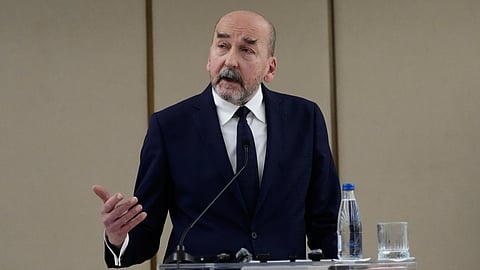

BELGRADE: Serbia's student-backed movement, which won an October election after rallying against corruption, on Friday named university professor Radomir Saicic -- who joined them early on -- as presidential candidate in next month's polls.
The December 27 vote comes three months after Aleksandar Vucic, who dominated Serbian politics for 14 years, cut short his second presidential term to run for prime minister but was soundly defeated.
The role is largely ceremonial but the president is responsible for nominating prime ministers and serves as commander-in-chief of the armed forces.
Saicic is a chemistry professor at Belgrade University and is a member of the Serbian Academy of Sciences and Arts. The 65-year-old was among the first university professors who joined the student-led protest movement.
"Now we have the opportunity to turn the freedom we fought for into lasting change," Saicic told a press conference.
"The assembly, the government and the courts must once again earn the trust of the people. The same applies to the institution of the president."
He pledged a "sovereign Serbia in which the constitution will be respected and in which every citizen will be able to live with dignity".
Genuine support
The Student List, on which Saicic was also a candidate, won 140 seats in the 250-member parliament. Explaining their choice, student representatives said they wanted a candidate "whose support was never merely symbolic, but genuine and steadfast".
"We believe citizens will recognise in him a commitment to upholding and representing the principles and values that have underpinned all our successes so far," a student representative told reporters.
Saicic was the one who announced the Student List's victory, setting off celebrations across the Balkan country as thousands poured into the streets of Belgrade and other cities.
"Students won and with them also hope that Serbia can be a country of justice, freedom and dignity," Saicic told cheering supporters at the movement's election headquarters on October 25.
Vucic, now an opposition MP, has repeatedly suggested his Serbian Progressive Party (SNS) might sit out the election, but a final decision is expected in mid-December.
Vucic himself is barred from running again as the constitution limits presidents to two terms.
The parliamentary and presidential elections followed nearly two years of protests sparked by the 2024 collapse of a railway station canopy in Novi Sad that killed 16 people.
The disaster at the recently renovated station, widely blamed on corruption, triggered Serbia's largest protests since the fall of strongman Slobodan Milosevic in 2000.
The movement's initial demand for a transparent investigation evolved into calls for snap elections, which Vucic eventually announced after nearly two years of resistance.
Serbia's newly elected lawmakers were sworn in on November 17, and have a 90-day deadline to elect a new government.
