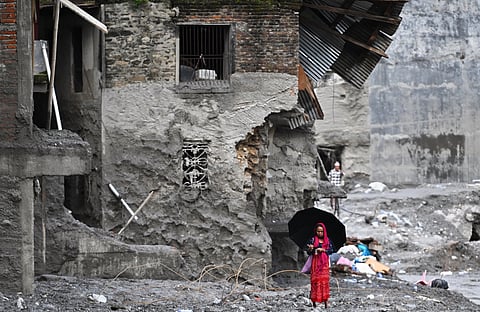

The deadly flash floods that ravaged the Nepal-Tibet border on August 26 have left at least 987 killed in Nepal and 16 killed in Tibet, raising the total death toll to 1,003.
The floods triggered by the collapse of a Himalayan glacier left thousands missing and damaged homes, roads, bridges and hydropower infrastructure.
Notably, the number of missing in Nepal dropped to 3,916, as rescue efforts entered a seventh day, and the bodies recovered rose.
According to the latest figures, 927 bodies have been sealed, of which 51 have been handed over to family members following identification, while 726 remain unidentified.
According to the National Disaster Risk Reduction and Management Authority (NDRRMA), 321 bodies were recovered from Chitwan, 216 from Nawalparasi East, 170 from Nawalparasi West and 95 from Nuwakot.
Similarly, 65 bodies were recovered from Gorkha, 55 from Dhading, 38 from Tanahun and 27 from Rasuwa. The flash flood has affected eight districts, the NDRRMA said, adding that of the 279 people injured, 168 have been discharged from various hospitals after treatment.
In China, state media say 546 people are missing, taking the overall number of missing to 4,462. The missing in Nepal include 583 foreigners from over 30 nations. Meanwhile, the missing in China include 261 foreigners from 23 countries.
Among the missing foreigners, Indians make up one of the largest proportions, with 275 citizens and another 128 people of Indian origin missing in Nepal, according to New Delhi.
85 US citizens are missing, according to the State Department on Sunday.
There are also 62 Ukrainians, 51 Malaysians, 42 Australians, and 33 British citizens, according to reports, including both Nepal's tourist board and embassies.
In India, authorities in Uttar Pradesh state said they had recovered 17 bodies from rivers flowing from Nepal, believed to be flood victims.
Indian authorities are seeking to identify them, and they are not included in the toll.
So far, more than 11,000 people have been rescued from flood-affected areas in Nepal. "Meanwhile, 22,000 security personnel, including those from the Nepal Army, have been mobilised to engage in search and rescue operations," officials said on Tuesday.
National Disaster Risk Reduction and Management Authority (NDRRMA) spokesperson Shanti Mahat pointed out that at least 16 helicopters have also been deployed for search and rescue operations in the affected areas.
The authorities have arranged temporary shelter for 2,970 displaced people at various holding centres.
A private-sector association representing power companies said at least 900 workers were unaccounted for at 12 hydropower projects damaged by the flash floods in Nepal’s Rasuwa and Nuwakot districts.
About 500 of those workers were believed to be trapped in tunnels. At least one expert said that some workers could have access to oxygen, but others warned that the chances of finding survivors were diminishing. As the rescue efforts intensified, four bodies were recovered from three mud-filled tunnels, Nepal’s army said.
Nearly a week after the disaster, some 65,000 people need emergency water, sanitation and hygiene materials, the U.N. said.
U.N. spokesman Stephane Dujarric told reporters that more than 22,000 children need protection, 2,600 children younger than 5 will likely need treatment for severe wasting, and around 10,500 pregnant and breastfeeding women need nutrition assistance. He also noted schools were damaged or destroyed or are being used as shelters for displaced people.
“More than 10,000 school-age children need psychosocial support, and preliminary reports indicate that 107 children may have been separated from their parents or caregivers,” Dujarric said.
Nepalese authorities on Tuesday issued a fresh alert over the risk of floods in several districts across eastern, central and western parts of the country, urging people living near rivers to remain vigilant and take precautionary measures.
There is a high possibility of flash floods in Nuwakot and Rasuwa districts, where water flow in smaller rivers and streams is expected to rise, according to a notice issued by the National Disaster Risk Reduction and Management Authority (NDRRMA).
With inputs from Associated Press, AFP, PTI
