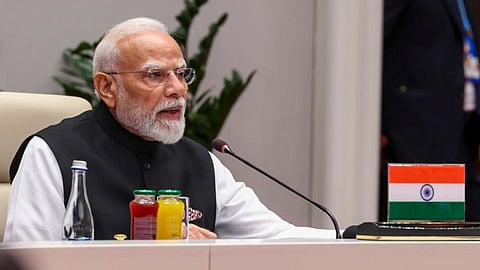

NEW DELHI: Prime Minister Narendra Modi on Tuesday urged the Shanghai Cooperation Organisation (SCO) to confront countries that use terrorism as an “instrument of state policy” and reject “double standards” in the fight against terror financing and recruitment, in remarks seen as a direct reference to Pakistan, which is also the next chair of the grouping.
Addressing the annual SCO summit in the presence of Pakistan Prime Minister Shehbaz Sharif and other world leaders, Modi called for a united effort to “dismantle the entire ecosystem” supporting terrorism, including financing, recruitment, radicalisation and safe havens.
“Terrorism continues to pose a serious challenge to humanity as a whole. In the fight against terrorism, we cannot remain confined to an action-reaction approach,” Modi said.
“We must dismantle the entire ecosystem of terrorist financing, recruitment, radicalisation, and safe havens. We must speak with one voice and make it clear that there can be no place for double standards on this serious issue,” he said.
“We must send a strong message to countries that use terrorism as an instrument of policy and provide safe haven and support to terrorists that terrorism can never be a strategic asset for anyone,” Modi added.
Though Modi did not name Pakistan, his remarks were widely seen as a criticism of Islamabad’s support for various militant groups targeting India. The prime minister also expressed concern over the continuing crisis in West Asia, saying conflicts in one region can have consequences far beyond their immediate borders.
“In today's interconnected world, the scope of security has become even broader. The crisis in West Asia has demonstrated that a conflict in one region does not remain confined to that region,” Modi said.
“Its impact is felt across the world, affecting energy security, maritime trade, and supply chains. The countries of the Global South bear the greatest brunt of such disruptions,” he added.
Meanwhile, Modi reiterated India’s position that tensions and conflicts should be resolved through dialogue and diplomacy rather than military action. “Therefore, India has consistently called for all tensions and conflicts to be resolved not on the battlefield, but through dialogue and diplomacy,” he said.
The prime minister also underlined the importance of peace and stability in Afghanistan for a peaceful Eurasia, saying India would continue its development and humanitarian assistance to the Afghan people.
“Our shared aspiration for a peaceful and secure Eurasia is also closely linked to peace and stability in Afghanistan. India has been contributing to the development and provision of humanitarian assistance to the people of Afghanistan and will continue to do so,” he said.
Modi also spoke about the importance of connectivity, while stressing that such initiatives must respect the sovereignty and territorial integrity of all countries, in an apparent reference to China’s Belt and Road Initiative (BRI).
Notably, India has been critical of the BRI because a portion of the China-Pakistan Economic Corridor, a flagship BRI project, passes through Pakistan-occupied Kashmir.
“India supports all efforts that connect markets, facilitate trade, and open up new avenues for development,” Modi said. “However, it is equally essential that such efforts respect the sovereignty and territorial integrity of all countries. This is also the fundamental spirit of the SCO Charter,” he added.
“Going forward, the scope of connectivity will become even broader. Along with roads, railways, and air corridors, we must simplify customs processes, promote digital documentation, and make logistics networks more efficient,” Modi said.
Modi’s address was based on three pillars — security, connectivity and opportunity — which he had proposed as India’s vision for the SCO at the previous summit. The prime minister said SCO cooperation should translate into tangible benefits for people, particularly young people, entrepreneurs and farmers.
“Our greatest strength is the connections between our people. For India, the SCO is a confluence of great civilisations, cultures, and ideas. Over the next twenty-five years of the SCO, people-to-people ties should remain at the heart of our cooperation,” Modi said.
“The true measure of our success should be how many new opportunities our efforts create for young people, how many new markets open up for our entrepreneurs, how much our farmers benefit from technology, and how much better the lives of our citizens become,” he added.
