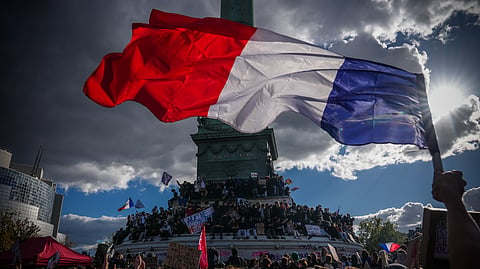

PARIS: High schoolers who have protested for weeks in France about underfunded schools and uncertain futures complain that it's a frustrating struggle to make themselves heard.
Demographically, it is true that young people in aging societies — which include France but also the United States and others — no longer have the same weight of numbers that helped their parents and grandparents make their mark when they were young.
In France, protesting pupils have managed to spark a national conversation about funding for schools that has morphed into broader unrest over cost-of-living struggles and heavy-handed policing.
In Serbia, two years of student-led protests unseated the Balkan country's populist strongman, Aleksandar Vucic, this weekend. In Albania, high schoolers and university students are swelling the ranks of an anti-government movement that for months has pressured Prime Minister Edi Rama to resign. Gen Z is also mobilizing in India, Nepal and elsewhere.
"We're seeing youth rising all over the world," Greta Thunberg, 23, said when she popped up at a school protest in the Paris suburb of Seine-Saint-Denis. "These movements are inspired by each other. People forget how connected Gen Z are across continents," she said.
But in France, Serbia and elsewhere, young people are also losing ground demographically to generations above them that are living longer and now outnumber them.
When they march, wave placards and shout slogans, the voice of young people isn't — at least mathematically — as dominant as it used to be.
Baby boomers outnumber the young
When rock 'n' roll sensation Johnny Hallyday, France's Elvis, had his first hit, "Souvenirs, Souvenirs," in 1960, the first kids born after the devastation of World War II were becoming teenagers, the initial wave of a postwar baby-boom generation that went on to reshape the country and, on a global scale, the world.
They got the Beatles, who played their first concert in France in 1964, the right for women to open a bank account without their husband's consent, in 1965, and the contraceptive pill, legalized in 1967. Young people were becoming a political, cultural, societal and sexual force and took on the established order when they hit the barricades in May 1968, hurling stones and catchy slogans like, "Be realistic, demand the impossible."
The demographics then were stacked in their favor. The 9.4 million teenagers and young adults in 1968 made up 19% of mainland France's population and comfortably outnumbered seniors. Just 13% of the population, or 6.3 million people, was aged 65 and above.
Today, it's the other way round. The 15 million people aged 65 and above, now 22% of the population, outnumber the 9.6 million 13-to-24-year-olds, who make up just 14% of the population.

The world's weight falls on young shoulders
For wealthier baby boomers — defined as people born between 1946 and 1964 — the world became their oyster.
In Europe, they grew up and secured first jobs in a postwar economic boom still fondly remembered in France as the "Trente Glorieuses" — 30 glorious years. They enjoyed the birth of low-cost air travel, the Cold War's end and the rise of personal computing.
In France alone, boomers squirreled away a staggering 9 trillion euros (about $10 trillion) in personal wealth that they'll pass on when they die, in what experts call "the great transmission."
But they're also leaving behind destructive climate change and record levels of human-made, heat-trapping pollution in the atmosphere as well as a world order shaken by unresolved wars in Ukraine and Iran that boomers started (Donald Trump was born in 1946, Benjamin Netanyahu in 1949 and Vladimir Putin in 1952).
In France, Gen Z is also inheriting record levels of poverty and crushing economic problems, including record public debt. They limit the government's ability to give protesting students everything that they want: Better schools with more teachers and no rat infestations, leaking roofs and other problems, and more opportunities after they graduate.
"I feel angry all the time, when I look at the world," said 27-year-old Camille Chesnier, protesting in Paris. "We feel powerless and we really don't know how to make ourselves heard."
Some suggest lowering the voting age
To give young people a bigger voice at the ballot box, there have been calls in France to lower the voting age from 18 to 16.
The idea's backers include left presidential candidate Jean-Luc Mélenchon. The 75-year-old has been the most prominent supporter of the high school protesters. He hopes their movement will translate into higher turnout by young voters, who cast fewer ballots than other age groups in the last presidential election in 2022.
Luc Rouban, a baby boomer himself and a researcher at Paris' Sciences Po school of political sciences, doubts that many 16-year-olds would use the right to vote, because "they lack political knowledge and aren't interested in politics."
"Why aren't young people joining political parties? Why are there fewer and fewer activists? Why are trade unions finding it increasingly difficult to recruit? That's where the problem lies: there's a kind of rejection of the system of representative democracy," said the 68-year-old Rouban.
But protesting pupils these past weeks have learned to build barricades, to wash police tear gas from their eyes and other political lessons that were a rite of passage for boomers, too. And they've won concessions.
Paris Cité University student Mathis Aversenq said students' demands echo those of workers because "the wages are too low, the people are getting laid off. It's harder and harder to work and live."
Fred Salin, a 33-year-old teacher at a Seine-Saint-Denis high school that has seen numerous protests, said he's been "blown away" by how politically sophisticated his pupils have become.
Kamal Hachkar, 49, another teacher at the school, said pupils are "expressing terrible anguish about the future" and that some of them have moved him to tears.
"For baby boomers who went through the Thirty Glorious years, it was very easy," he said.