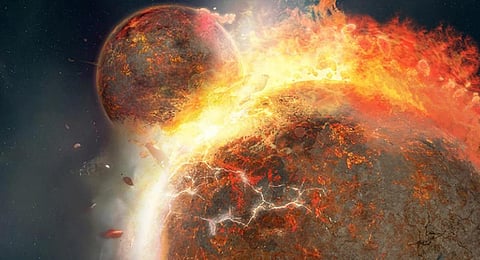

About 4.51 billion years ago, a Mars-sized planet named Theia slammed into the early Earth, causing a largish residual splinter from the collision to shoot out and form our Moon. But while we can see the Moon almost every day and night, whatever happened to Theia?
While searches in the asteroid belt and surrounding regions have yielded no clues about the presence of the remains of Theia after it slammed into the Earth, and was presumed to have disintegrated, researchers from Caltech Institute of Technology have now concluded that the planet has been inside Earth all these billions of years. This is an outcome of an earlier discovery. Geophysicists had already discovered two continent-sized blobs in the 1980s. These were found to be composed of unusual material. One was located under the African continent, the other under the Pacific Ocean — each, almost twice the size of the Moon. Both these blobs, which came to be known as Large Low-Velocity Provinces (LLVPs), were found to have compositions that were different concentrations of elements compared to the mantle around them. The LLVPs were discovered when scientists observed that the seismic waves travelling through layers below the Earth’s crust showed huge variations. On studying these variations closely, they discovered that these changes were determined by a marked change in densities that these two large blobs had. They were found to have very high levels of iron, which contributed to their much higher densities, which caused the seismic waves to slow down while passing through them. It was this observation that led to them being referred to as “large low velocity provinces”. Interestingly, although they had discovered the LLVPs, they had no clue what the two blobs were then.
That process started in 2019, just by chance. That was when the lead researcher, Qian Yuan, OK Earl Postdoctoral Scholar Research Associate in the laboratories of Paul Asimow, the Eleanor and John R McMillan Professor of Geology and Geochemistry; and Michael Gurnis, the John E And Hazel S Smits Professor of Geophysics and Clarence R Allen Leadership Chair, director of Caltech’s Seismological Laboratory, who is also director of the Schmidt Academy for Software Engineering at Caltech, had what he calls an “Eureka moment”. That happened when he was attending a seminar where Mikhail Zolotov, professor at Arizona State University, presented the giant-impact hypothesis, and stressed on the mysterious “disappearance” of the impactor planet, Theia.
Yuan put two-and-two together, recalling the high iron composition of Moon and high iron presence in the LLVPs to put in place a deduction.
He then worked on different simulation models to check various emerging results for the chemical composition of Theia and the manner in which it could have impacted Earth. These models confirmed Yuan’s deduction, which matched with the physics involved in the collision between Earth and Theia. The simulations also indicated the manner in which Theia got incorporated into Earth’s mantle, where they evolved into two blobs at the boundaries between the planet’s mantle and core — which were discovered as LLVPs three decades earlier, but now could be considered as the remains of a planet within our own planet.
(Source: Caltech Institute of Technology)