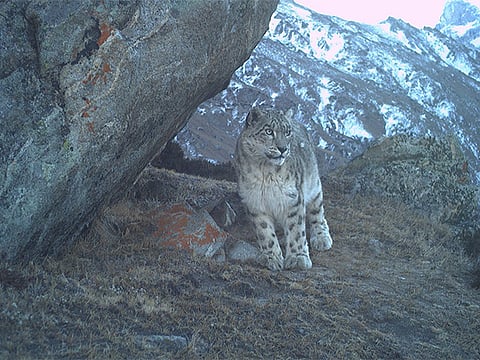

The mystery of the snow leopards and their struggle for survival is being slowly understood by researchers and forest department officials in the politically and environmentally sensitive and fragile ecosystem regions of Jammu & Kashmir and Ladakh. The elusive big cats, also known as the ‘ghosts of the mountains’, are found to be no longer a migrant population in J&K as over a dozen snow leopards have made the region their home. The recently released camera trap study report prepared by Nature Conservation Foundation (NCF) revealed that the J&K region houses around 20 snow leopards, most of them being outside protected areas.
Following the directions of the Central government, the Snow Leopard Population Assessment of India started in 2020 but the pandemic slowed it down. Jammu & Kashmir, Ladakh, Himachal Pradesh, Uttarakhand, Arunachal Pradesh and Sikkim were listed for the assessment. The exercise was completed in Himachal Pradesh in 2021. It took another two years in Uttarakhand, Sikkim, Arunachal Pradesh and Ladakh and in J&K, the exercise was wrapped up this year.
The NCF conducted the study in Himachal Pradesh and J&K, whereas Dehradun-based Wildlife Institute of India (WII) studied Ladakh and Uttarakhand. The Wild Wide Fund for Nature (WWF) took up the study in Sikkim and Arunachal Pradesh.
As per reports, there are 400 snow leopards in Ladakh, 80 were recorded in Himachal Pradesh, 100 in Uttarakhand and 20 each in Sikkim and Arunachal Pradesh.
According to the Global Snow Leopard and Ecosystem Protection Programme, the estimated number of snow leopards in the world ranges between 4,000 and 6,500 and India houses one-ninth of the global population. As per latest reports, there are around 718 snow leopards in India, said Shahid Hameed, Wildlife Research and Project Coordinator at NCF, who undertook the study in J&K.
There were reports of sightings in J&K, but there was no verifiable report to ascertain whether the big cats were residents or seasonal wanderers, he said. So stretching the all India assessment a little more, it was decided to undertake a detailed study. A landscape study of the region was also undertaken to understand if they came from Ladakh or Himachal Pradesh. Camera traps were strategically located from September 2024 to May 2025 to understand the region and the species, Hameed added.
The study was conducted across the Kishtwar Himalayas. The snow leopards were recorded during the winter months in both Paddar (Jammu division) and Zojila (Kashmir division). Over 3,000 night camera traps were placed across the Kishtwar High Altitude National Park (KHANP), Paddar and Zojila. The sighting of mother with cubs in Kishtwar also confirmed it to be a breeding population.
In the words of the research team, the findings were ‘amazing.’ The snow leopards were seen in temperatures from 5-7 degree Celsius and even in (minus)-10 degree Celsius. As a part of the study, the teams also captured 16 mammals in the region. The list included Stone marten, Asiatic Ibex, Red Fox, porcupine, pika, musk deer, mountain weasel, Himalayan stoat, long-tailed marmot, Himalayan brown bear, common leopard, Kashmir Grey Langur, Rhesus macaque, Leopard cat, jackal and Grey wolf.
The NCF teams and the J&K forest department officials were unanimous that unlike tigers or leopards, it cannot be concluded if the snow leopard population has increased or declined. “This is for the first time a study has been undertaken in the J&K and Ladakh regions. So far, over the years, wildlife protection was not a priority of the administration of the regions, given the situation. But now as the political situation have stabilised and development works have paced up, environmental aspects are also becoming important just like any other state and region. A record of the population will be maintained from now on for future assessments. Their region will also be earmarked for protection,” said an official from J&K forest department, not wanting to be identified.
Street dogs a problem
While forest officials and conservationists take a pat on their back for the snow leopard sightings in the J&K valley, they point to the urgent need to address the threats the shy and sensitive species — Panthera uncial — faces, especially from street dogs. “The tourism influx not just boosts the economy of J&K but also brought along other problems. Rapid development has made the sensitive Himalayan regions vulnerable to natural disasters. It has also led to a rise in garbage and vehicular pollution and the street dog population is much bigger. They have increased dramatically since a decade and become a menace around forest areas,” added the forest official.
Official sources added that snow leopards also face threat from people in J&K who are complaining of attacks on their sheep and goats for food and hence coming in conflict with humans and dogs. Dr Kulbhushan Singh Suryawanshi, scientist at NCF said, the snow leopards are very sensitive to the terrain and are found in very high and low elevations too. They weigh around 30 kg-40 kg and unlike other leopards, the elusive cats do not prey on dogs. But packs of dogs have found to be attacking snow leopards and eating away their prey base, thus affecting the species.
Experts pointed out that there are 59 tiger reserves in India and the focus of the state and Central governments is on protecting their habitats. “But the same is not being done in case of snow leopards. To protect the species across the regions where they are found, the farmers and locals should be quickly compensated for death of livestock. The areas the snow leopards inhabit should be identified and protected from further development and most importantly, the areas should be kept clean and stray dog population needs to be curtailed. The help of locals, government officials and tourists is important,” they added.
