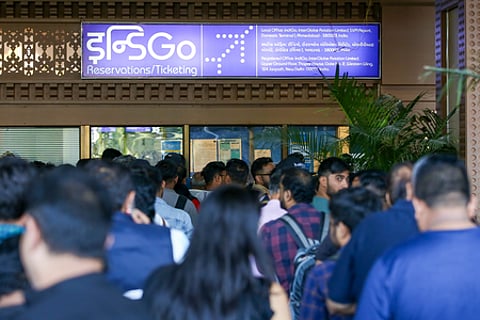

India’s aviation sector is not for the faint-hearted. In the last 13 years, three major airlines — Kingfisher Airlines, Jet Airways and GoFirst — ceased operations while numerous smaller players perished in the aftermath of the Covid-19 pandemic. The government also pulled out from this cash-guzzling sector and gave the reins of Air India to its previous owner — the Tata Group. Amid all the shake-up, one airline continued its upward journey and it seemed nothing would interrupt its meteoric rise until last week.
Since its start in the mid-2000s, the low-cost carrier IndiGo has differentiated itself from the herd. The airline’s strict financial prudence, record-breaking On-Time Performance, uniformity, and ever-expanding network helped it grow fast and become formidable. IndiGo also navigated the pain caused by the Covid-19 pandemic and expanded its global footprint.
Except for professional issues between its two promoters, it seems whatever IndiGo was doing was destined to succeed. However, the dream run met a reality check last week. IndiGo cancelled more than 5,000 flights since last Tuesday due to a severe crew shortage.
The rise and rise of IndiGo
Launched by Rahul Bhatia of InterGlobe Enterprises and US aviation veteran Rakesh Gangwal, the former CEO of US Airways, IndiGo took off on August 4, 2006. Most experts attribute the airline’s success to prioritising punctuality and maximum plane turnaround times from day one. Some analysts estimate that IndiGo’s cost of operations is 10-15% lower than the competition.
A smart financial tactic — sale-and-leaseback (SLB) — method also fueled its growth. IndiGo bought brand-new jets in bulk from Airbus at a discounted price. It then flipped the aircraft to lessors for instant cash, then rented them back on 6-8 year terms. This kept its fleet among the world’s youngest, unlocked funds for rapid scaling, trimmed debt, and saved it from the burden of managing an ageing fleet. All these factors helped in sustaining profit even as fuel prices moved wildly and fixed costs remained at a higher level.
In less than seven years since commencing operations, IndiGo claimed the top spot by domestic market share amid fierce rivalry from full-service rivals. By 2014, IndiGo matched Air India and Jet Airways with a 100-plane fleet and surged past 35% domestic share in FY15. In 2015, the company went public and its IPO raked in over $450 million amid massive oversubscription.
What followed next was a price war and cutthroat competition in the Indian skies. IndiGo not only won this battle but also captured market share from rivals that collapsed one by one. Earlier this year, IndiGo briefly became the world's most valuable airline by market capitalisation, surpassing Delta Air Lines. The carrier also started expanding its international presence, particularly in the short-haul destinations. Now IndiGo has direct flights to Western Europe and has plans to go even further.
In 2019, it inked a blockbuster deal for 300 A320neo-family jets, including A321XLRs for extended hops. Post-Covid recovery, 2023 brought a historic 500 A320-family order, the largest-ever by a single airline, plus 60 A350s for long-haul ambitions. Today, IndiGo flies 2,200-2,300 daily flights, holds 64% domestic dominance and has codeshares with many global carriers.
Bleeding losses
India’s aviation sector has suffered heavy losses, a key factor behind numerous airline failures over the past 30-35 years. Significantly higher fixed costs, accounting for 55-60% of expenses with minimal flexibility, continue to be the biggest headache for operators. Fuel cost dominates at 30-40%, hit hard by state levies and wild swings amid global conflicts. In November, Aviation Turbine Fuel (ATF) prices were up 4.4% year-on-year.
Leasing aircraft, which are tied to long-term dollar contracts, has now emerged as a tension for carriers as the rupee continues to slide. InterGlobe Aviation, IndiGo’s parent, reported a net loss of ₹2,582 crore in Q2FY26 due to adverse currency movements on dollar-denominated obligations. Airport fees, peaking at major hubs like Delhi and Mumbai, add to the pain.
While the intensity of price wars has reduced in the industry, airlines have started taking hits due to geopolitical tensions. Air India in October informed that it has incurred losses of `4,000 crore over the past few months due to restrictions on flying over Pakistan since April 2025.
The sector also continues to face supply chain bottlenecks and engine failure-related aircraft groundings, as per ratings agency ICRA. As of March 31, 2025, around 133 aircraft across select airlines were grounded, representing 15–17% of the total industry fleet. These operational setbacks have led to increased costs, including grounding-related expenses, higher lease rentals for replacement aircraft, and reduced fuel efficiency.
The aviation sector’s combined financial performance has deteriorated significantly in recent years. While Indian carriers reported a total net loss of ₹924 crore in FY2023–24, the figure widened to ₹5,290 crore in FY2024–25.
Data shared by the aviation ministry indicates that Air India sustained a loss of ₹3,975 crore while Air India Express losses stood at ₹5,832 crore in FY25. Akasa Air saw a loss of ₹1,986 crore, and Alliance Air loss came at ₹691 crore. SpiceJet also remained in the red with a ₹55 crore loss. IndiGo, however, reported a profit of ₹7,253 crore in FY25 compared to a ₹8,167 crore profit in the previous fiscal.
The Indian aviation sector is projected to report a wider net loss of ₹9,500-10,500 crore in FY2026. The deterioration is linked to moderating passenger growth coupled with higher deliveries of aircraft, which increase capital and operational expenses.
A mixed bag
India’s aviation market has become a playground of two strong players — IndiGo and the Air India Group. IndiGo is India's biggest airline, with a market share of around 64% and a fleet size of 417 aircraft at the end of September. Air India Group, which has a market share of 27%, has a combined fleet of 302 aircraft, including 115 at its budget carrier Air India Express. Air India, owned by India's Tata Group and Singapore Airlines, operates non-stop flights to 39 destinations across five continents.
Most market experts believe having two strong players is good for the industry as this has also led to higher airfares due to reduced competition. However, for consumers, it is worrisome as seen in the latest meltdown at IndiGo.