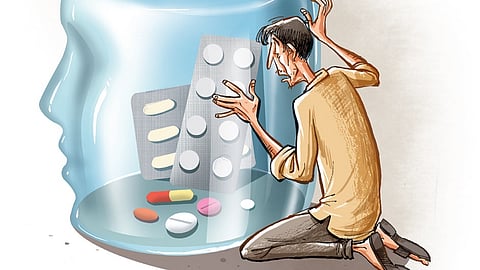

Mental ill-health is increasing globally, and India is no exception. The need of the hour for India is to invest in mental health manpower, services and research, to protect its tomorrow, said Dr Koushik Sinha Deb, additional professor, department of psychiatry, AIIMS.
In an interview with Kavita Bajeli-Datt, he says people, especially in cities, nowadays are more open about discussing mental health issues, but the associated stigma may not have come down.
Edited excerpts:
What is the current status of mental health in India? Are we giving attention to mental health in India?
Mental ill-health is increasing globally, and India is no exception. Mental resilience is being eroded by social instability, war and economic insecurities. The term “mental health crisis” has become jaded by overuse, a fact which is alarming by itself. Mental health has become common. According to national survey data, the lifetime prevalence was 13.7%, while substance use disorders was 22.4%. It means that it is more common than heart diseases (13-15%), diabetes (8.3%), cancer (all) (11%), active tuberculosis (1-3%). Next is how many years of life are lost due to mental health? The DALY (Disability-adjusted life years) is 16% of all DALYs. This means that it is less than heart diseases and diabetes, similar to TB and more than cancer, kidney and liver disorders. In India, the treatment gap is 70-92%. Around 70-92% of people with mental disorders do not get treatment in the country. The government spends 0.05% of GDP of India, and 1.11% of the Budget (2024-25) on mental health. In comparison, developed countries spend 5% and 18% of their GDP on mental health.
However, there is hope. The current government has initiated several flagship activities on mental health. Notably, the ‘National Tele Mental Health Programme’ was launched on October 10, 2022, to improve access to mental health care services across the nation. National Mental Health Programme (NMHP) plans to establish 25 centers of excellence. The government is strengthening mental healthcare at the primary level by upgrading over 160,000 health centers to Ayushman Arogya Mandirs, integrating mental health services into comprehensive primary healthcare. Starting from the academic year 2024-25, a B.Sc. Clinical Psychology (Hons.) program has been introduced to increase manpower. Mental health insurance has been introduced in 2020 after direction from the honorable Supreme Court. Finally, the ‘Rights of Persons with Disabilities Act, 2016’ (RPwD Act) has introduced reservations in education and jobs for persons with mental disabilities (1%) for the first time.
Do we have enough trained mental health professionals?
India currently has an enormous disparity between the number of mental health professionals required and the number trained. Although the training of Psychiatrist (MD doctors who are trained in Psychiatry) have significantly increased in the last five years, the number of other mental health professionals remains very low. Mental health services require a team of professionals other than doctors for effectively delivering services, particularly in the community. International guidelines suggest the need for around 10 times more mental health professionals per Psychiatrist.
Psychologists (professionals trained in counselling and therapy) form the second pillar of mental health management but are significantly less than needed. Most hospitals do not have any training curriculum for clinical psychology to ensure quality hospital training of Psychology students. Other support staff, including psychiatric nursing, psychiatric social worker, mental health community worker are even less in the country.
The scarcity is accentuated by three additional factors. First is that psychiatrists/psychologists remain concentrated in major cities for practical reasons of infrastructure, as well due to lack of awareness and acceptance of mental illness in the greater non-urban country. Second, a global shortage of mental health professionals results in significant pull on trained manpower (doctors, psychologists and nurses) to migrate abroad, for better pay and quality of life; and third, most hospitals do not have adequate posts for clinical psychologist, psychiatric nurses or social workers, in comparison to medical doctors. Resulting in a significant push to migrate outside India.
Are we as a society have become more open about talking about mental health issues now?
Somewhat, and in a complicated way. Compared to our training days in the 1990s and 2000s, currently at least in cities, people are more open in discussing mental health issues. However, there is a possibility that the stigma may not have reduced, but may have just changed colour. People although are ready to talk, acceptance of medications or need for long term treatment remains low. Illnesses like depression and anxiety are less concealed, thanks to massive public health campaigns by the government, psychiatric fraternity, WHO and even Bollywood. However, serious psychiatric disorders like psychosis are still swept under the table and never talked about.
Additionally, information often overwhelms truth in the age of social media, where 10 second clips provide one-minute solutions to serious life problems. Ethical debates are ongoing across the world, if such “depression cures” and “depression identification” are helping in reducing stigma; or are actually harming sufferers by providing false identification, incomplete knowledge, charlatan cure and by preventing proper medical consultation.
We are seeing a rise in digital addiction in India. Is there any way to safeguard the vulnerable young minds? Has it also led to cyber bullying? Your comments?
Every society and culture will invent new tools and instruments. Digital media and the internet are cultural tools of our times. All instruments require a period of training for efficient use, depending upon their potency. For example, one would not hand over a child the keys to a car without proper training and license, and definitely not the keys to a plane. Parents, similarly, need to train their children on the proper use of digital media. Digital media itself is neither good or bad, it just “is”. Before a certain age, limiting all screen time and promoting physical activities in the real world, where all five senses are engaged, significantly improves learning and development. When introducing a child to the world of digital media, initial supervision ensures that the adolescent knows to navigate the risks and benefits of the web. Unsupervised initiation into the world of digital media is akin to leaving a child with an electric saw, and no manual.
Cyber bullying is indeed a prime example why initial parental supervision remains so crucial. Bullying has been unfortunately existing in the society since time immemorial. However, previously the victim could seek refuge in safe places. A class, a teacher, and home meant a strategy for escape. Cyber-bullying robs the victim of all such safe spaces. Cyber bullying is ever-present, relentless and permanent. Communication with children remains the key to understanding if they are being intimidated or persecuted.
What are the factors that is driving youngsters, especially students to suicide?
Suicide is indeed a complicated topic. In a recent book - Suicide: Indian Perspectives) my colleagues and I have discussed the sociocultural factors behind its cause. At the cost of oversimplification, it can be said that a complicated combination of mental problems (sadness, hopelessness), social factors (stigma of failure) and family factors (scolding, denouncement) result in the formation of a nidus of an idea of self-harm. Although most individuals can manage this distress most of the time, there are instances when the situation escalates, making the distress overwhelming and leaving all alternative solutions seemingly unattainable.
Do you think India is at par with the Western world in providing mental health treatment?
Definitely not, at least when comparing the resources available and the proportion of GDP spent. However, it is increasingly being realized that the highly individualistic and insurance based medical services of the West may not be the only path (or even a preferred path) for providing mental healthcare to the people of our country. It is necessary for India to devise strategies that play to our unique strengths. Our families might be overinvolved and intrusive in our personal life, but they are an astounding source of support in times of need. The cost of treatment in India through generic medicine is hundred times less as compared to the western world. Our doctors are not pressurized by insurance companies to discharge patients at the earliest. Even without government enforced reservation, our communities have always provided jobs and support to persons with mental illness. Our country is not perfect, but it has a unique beauty in its chaotic rhythms. The global humanitarian crisis is currently at a record high with 56 ongoing conflicts and more countries at war than in World War II. Between pandemic, politics, price-rise and climate crisis, mental distress is expected to increase exponentially. India needs to invest in mental health manpower, services and research, to protect its tomorrow.
