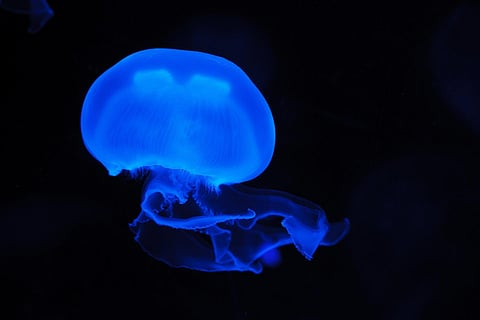

The menace of weeds, pests and pollutants is not just limited to forests and urban landscapes; it has become a concern for aquatic life too. A new addition to the list is the jellyfish with marine experts, aquaculturists and forest department officials of southern India now increasingly reporting their concern.
The rising incidence of tourists, adventure enthusiasts and fishermen getting stung by these marine species is not the only hazard, the growing population and sightings of jellyfish is a direct indication of a disruption in the natural ecosystem.
Most turtles, especially the Olive Ridley and fish species, feed on jellyfish. A rise in the prey species simply shows that there is a decline in predator species, just like it is in the forest ecosystems. Experts point out that earlier the rise in jellyfish population was limited to southern Gujarat but is now being reported from the coasts of Karnataka and Kerala to a large extent. Fishermen in Karnataka have also reported a rising number of jellyfish caught in their nets.
“Many fishermen are complaining of the rising jellyfish population and them getting caught in the nets. Their rise is a direct indication of an imbalance in the ecosystem but the exact reason needs to be studied in length,” said Shahnawaz, marine biology technical consultant with Karnataka Forest department.
Chandrashekhar, range forest officer of Karwar, said Olive Ridley turtles primarily feed on jellyfish and if there is a rise in prey species, it shows there is a decline in turtle population. Many fishermen and locals have reported the sighting of jellyfish in the coasts which calls for serious government attention. Data from other regions is also being obtained to study if there is a pattern.
A Kerala Forest department official said similar is the pattern in the southern state and Goa as well, where fishermen and tourists are also complaining of being stung by jellyfish.
Marine expert M D Subash Chandran said jellyfish can survive in adverse conditions and a rise in their population is also because of the varying sea temperature conditions. They are now being found in the estuaries too.
A marine expert with the Ministry of Environment, Forests and Climate Change, not wanting to be named said, jellyfish come up in highly polluted waters and in areas where human interference is very high. Their tentacles draw fish and when the latter are attracted they are stung. Jellyfish are venomous and the sting can also cause paralysis. While it is a concern in western countries, the Indian coasts have started to gradually report a rise in cases, he added.
Chandran said that there is a decline in the population of Olive Ridley turtles because of the increasing human interference in controlling sea erosion. Olive Ridleys come to shore for nesting for which they follow a traditional path which is passed down generations but if the path is obstructed, then they give the location a miss. That’s what is happening over the years.
Various government departments are now erecting sea walls, throwing boulders and sand bags on the shore and into the sea to address erosion. This has not just impacted marine life but also affected Olive Ridleys nesting and led to a rise in jellyfish population over time which is now visible, added the MoEFCC official.
“Jellyfish were earlier found in abundance off Gujarat coast, now they are being reported in Karnataka and Kerala coasts. The rise in their number shows there is a rise in organic and inorganic matter in the sea which is providing them a congenial atmosphere to breed. This is not good for the environment and the matter has now drawn the attention of the National Green Tribunal too,” the official said.
