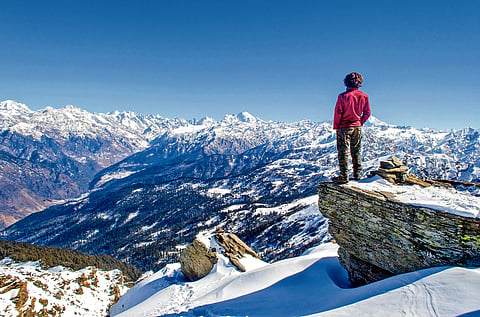

If you’ve already seen the mainstays like Gulmarg or Pahalgam and want something more raw and less touristy in Kashmir, then Sinthan Top is absolutely worth visiting! Sitting at 12,500 feet, it is a pass that connects the Anantnag district of Kashmir with the Kishtwar district of Jammu. Road-trippers, please note that the drive from Daksum to Sinthan Top is one of
the most scenic in India, featuring dense pine forests that give way to sharp, hairpin bends and sheer mountain walls. It is often the first place to get snow and the last place to lose it. Even in June, you are likely to find massive snow walls lining the road. If you visit between April and early June, you’ll drive through narrow corridors of snow that can be 10–20 feet high, which is an experience in itself.
Daksum & Achaba are two unmissable stops on the way from Anantnag. Daksum is a lush, quiet forest retreat with the Bringhi River flowing through it, which is perfect for a quiet picnic. Achabal features a historic 17th-century Mughal garden with unique ancient water engineering. Additionally, Kokernag Botanical Garden, located on the route, is home to the largest freshwater spring in Kashmir and is famous for its trout hatchery.
From the summit, you get a panoramic view of the Pir Panjal and Greater Himalayan ranges. On a clear day, you can see both the Kashmir Valley on one side and the Chenab Valley on the other. Because Sinthan Top holds snow longer than almost anywhere else, it has become a niche spot for activities like skiing and snowboarding, even in April and May.
During the summer months, the slopes around Sinthan are dotted with the mud-and-stone huts (kothas) of the Bakarwal and Gujjar shepherds. Because there is zero light
pollution at the top, if you manage to stay late (though most return to Kokernag), the night sky is incredibly clear for stargazing. About 10 km from Daksum, there is a small trail (3 km) that leads to Girsar, a crystal-clear spring that’s a favourite for locals but rarely seen by tourists.
Aarshan is another notable spot! This high-altitude meadow about 21 km past Daksum is where bhojpatra (Himalayan Birch) trees grow. The bark of these trees was used in ancient India to write manuscripts. The Bringhi River, which follows you for much of the drive, is famous for its Rainbow Trout. Before concluding this getaway, take a detour to Kokernag, where you can savour fresh trout prepared in traditional Kashmiri style at several local restaurants and government fisheries.
