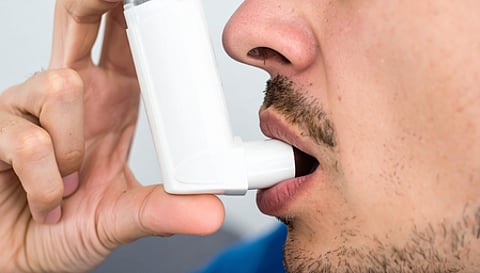

For 34-year-old Vivek Kiran, a marketing executive, the daily commute to his office in Thiruvananthapuram isn’t measured in kilometres, but in the deliberate rhythm of his breath. While other commuters briskly navigate the foot overbridge at Thiruvananthapuram Central to catch the return train to Kollam, Vivek pauses halfway across. To a casual observer, he appears to be checking his phone. In reality, he is waiting for the tightening sensation in his chest to subside, calculating the metabolic cost of the next 20 steps. This is the quiet, rhythmic negotiation of life with asthma, a condition that transforms the mundane architecture of daily life into a series of calculated risks.
Asthma is often publicly perceived through the lens of the acute crisis, yet for millions, the true burden lies in the “invisible middle” — the daily, low-grade burden between acute attacks. It is a persistent shadow that dictates how fast one walks or whether a social invitation is accepted. Much of the struggle remains hidden, quietly shaping daily choices and confidence. Dr Arjun P, senior consultant in pulmonology at KIMSHEALTH, Thiruvananthapuram, notes that these challenges are relentless. “Patients often struggle with routine tasks like climbing stairs in multi-story homes in cities, where chest tightness strikes unexpectedly, limiting work, school, and family time,” he explains.
The local environment plays a significant role in this struggle, particularly in a coastal city like Thiruvananthapuram. Vivek often finds that his symptoms worsen during the monsoon or on particularly humid mornings. Dr Arjun highlights that India’s tropical climate significantly amplifies these woes. “High humidity in coastal areas fosters mould and house dust mites in homes, triggering attacks,” he says. He also warns of triggers specific to modern urban living: “In high-rise buildings and apartments, pigeons are a major source of allergy. Lush greenery releases pollen from coconut palms and rubber trees, while urban pollution irritates airways.”

This physical battle is frequently compounded by social and psychological barriers. Dr PS Shajahan, professor and head of pulmonary medicine at Government Medical College Kollam, who treats a high volume of coastal Kerala patients, observes that a significant stigma still surrounds the diagnosis. “There remains a significant social stigma surrounding asthma and its treatment,” Dr Shajahan explains. “Many patients are hesitant to even admit they have the condition to their doctors. This is likely because the primary symptom — shortness of breath — carries a heavy emotional burden. Instead of acknowledging asthma, many patients minimise their struggle, describing it as a ‘persistent cold’ or ‘recurrent phlegm’ that simply won’t go away.”
For Vivek, this minimisation became a way of life until it began to erode his confidence. He recalls skipping office cricket matches or avoiding the stairs in his apartment complex, fearing the judgement of peers who might view his breathlessness as a lack of fitness. Dr Shajahan points out that the origins of such struggles are increasingly complex. “While genetics and allergies are the primary causes of asthma, the disease can also manifest in individuals with no family history,” he says. “Our modern living conditions and daily environmental exposures are major contributing factors that can trigger the onset of the condition.”
Beyond stigma, treatment is further complicated by deeply rooted cultural beliefs about diet. Vivek spent years avoiding curd and citrus fruits, believing they caused mucus buildup, which only left him feeling more fatigued. Dr Shajahan clarifies that these restrictions are largely unnecessary. “Contrary to the popular myth that certain foods ‘create phlegm,’ asthma patients do not need to restrict their diet unless they have a documented food allergy,” he notes. While artificial colourings or very cold foods during a flare-up can be triggers, “many patients inadvertently compromise their overall health by avoiding nutrient-rich foods out of a misplaced fear.”
The path to reclaiming a normal life requires moving beyond the “just adjust” mentality. Modern medicine provides the tools to manage these environmental and physiological hurdles, but it requires proactive care. Dr Shajahan warns that ignoring the condition is a “dangerous mistake,” as no one should have to suffer through treatable symptoms.
Today, Vivek still pauses on the bridge, but now he counts his breaths not with dread, but with the calm of someone who finally knows what he’s managing.