
The pilot’s announcement comes before the descent. Somewhere over the Himalayas, with views of snow-covered peaks filling every window, passengers are quietly warned that the altitude of Leh affects some travellers before the aircraft has even landed. It is not a formality. At 3,500 metres, the body needs time to negotiate terms with the thin air and the consequences of skipping that negotiation — nosebleeds, oxygen masks, splitting headaches — have a way of cancelling the entire trip. Diamox and dietary adjustments help, but the most effective prescription for those first 48 hours is the one nobody wants to follow: rest and reset. The question, then, is how to rest well while also exploring a destination as exotic as Leh, Ladakh.
We based ourselves at The Postcard in the Himalayan Willows in Stok, a village that sits above Leh and frames the entire valley into one view. There is also a practical advantage to basing yourselves here rather than the usual Leh town. The village sits at a higher elevation than the city below, which means your body is already quietly adapting to conditions closer to what you will encounter further into the journey — Khardung La, Pangong, the high passes. From Stok, you look down at the miniature bustle of Leh city and the airport runway, while Stok Kangri — massive, snow-covered peak — rises behind you.
Day one must be dedicated to the ‘art of doing nothing’, perhaps a slow walk once you have fully caught up on sleep. Stroll up the hill from the hotel for a kilometre and you will reach Stok Palace and Museum, the current residence of the Ladakhi royal family. Witnessing the ancient thangkas and the queen’s turquoise-encrusted perak headdresses housed in here is sufficient exertion for the day. Alternatively, find a cosy spot and sit with a cup of chai and a plate of mok mok at the hotel — marvelling at the mountains. It is not a bad way to spend the day while your lungs recalibrate through the night.
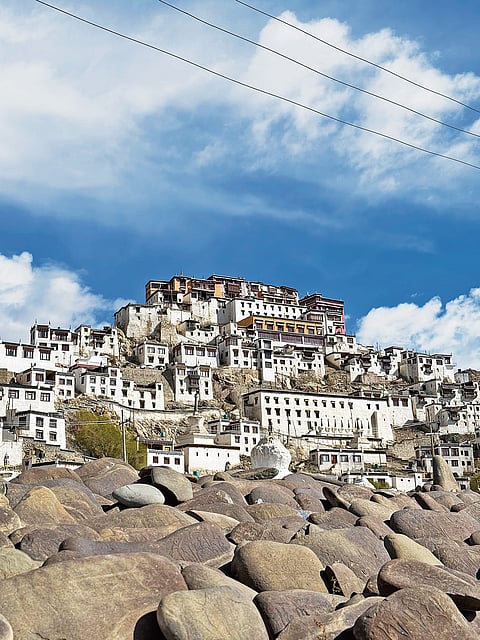
Rise early the next morning and journey towards Thiksey Monastery. The 12-storey complex is best experienced when the monks are conducting their morning prayers. Inside, a two-storey Maitreya Buddha sits in complete serenity. Look for the bhavacakra (Wheel of Life) murals, tengyur and kangyur (ancient Buddhist scriptures) wrapped in silk, the Tara Temple and Lamokhang Temple looking over the Zanskar range. Shey Palace, the former summer capital of Ladakh, follows. The giant copper-and-gold-gilded Buddha here is the highlight. End the day at Sindhu Ghat on the banks of the Indus. In early summer, the water runs a fierce glacial blue and the riverbanks may still carry a thin crust of ice at the edges.
Day three can be about descending from the quiet of Stok into Leh Market. The lanes are narrow and layered — the smell of freshly baked khambir, Ladakhi bread, cuts through the cold air. Leh Palace looms above the market: a dark-timbered nine-storey structure that appears carved directly from the mountainside. Climbing to the top of it opens out into a view of the old town — a dense maze of mud-brick houses that have survived centuries of invasions and harsh winters.
As the day fades and the temperature drops, drive up to Shanti Stupa. The white dome sits above the valley and offers the full panorama of Leh. During your drive through the city, keep an eye out for grand, ornate arches and apricot blossoms in Summer. Fragile pink and white petals appearing on bare branches against a backdrop of snow — it looks like spring and feels like winter, which is Leh in a single image.
By the time you finish this circuit, your body will be primed. The climb to Khardung La, a deep dive through Nubra Valley or the long drive to Pangong Tso won’t feel like a struggle, but like the grand finale you’ve prepared for.
