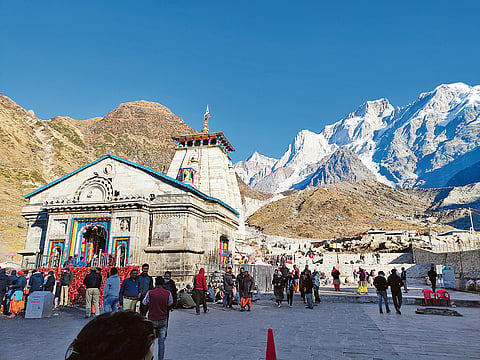

As the doors of the Kedarnath shrine open for the 2026 season, the focus is often on the long trek and the darshan. However, for those looking to stay a day or two longer, the high-altitude valley and its surrounding ridges offer some of the most surreal landscapes in the Garhwal Himalayas.
Bhairav Nath Temple, located just 500–800 metres uphill from the main Kedarnath Temple, is considered a mandatory stop for many. It is dedicated to Lord Bhairav, the fierce guardian deity of the valley, who is said to protect the shrine during the heavy winter snows. It offers the single best birds-eye view of the entire Kedarnath valley and the Mandakini river snaking below. Right behind the main temple lies the final resting place of Adi Shankaracharya, the 8th-century seer who consolidated the Char Dham. After the 2013 floods, this area was beautifully reconstructed. It now features a stunning 12-foot stone statue of the seer in a meditative posture.
For those with a bit of stamina, Vasuki Tal is a stunning high-altitude trek (eight kms from Kedarnath). At 4,135 metres, this lake is crystal clear and surrounded by the towering Chaukhamba peaks. You’ll find the rare Brahma Kamal blooming here during this season. Alternatively, Gandhi Sarovar, a relatively easy three km trek from the temple, leads you to this pristine lake, which sits right at the mouth of the Chorabari Glacier. The lake provides a mirror-like reflection of the Kedarnath peaks, making it a photographer’s dream.
Most people rush through the trek from Gaurikund, but if you look around near Jungle Chatti (about four kms into the trek), there are several unnamed, glacial waterfalls. Here on, you are technically walking through one of the richest biodiversity hubs in the Himalayas, Kedarnath Wildlife Sanctuary. If you move away from the noisy pony tracks, you might spot the Himalayan Monal (a rainbow-coloured bird) or the Musk Deer. The sanctuary is famous for its dense forests of oak and rhododendron, which turn bright red in the summer.
Made famous by high-profile visits in recent years, Rudra Cave: The Meditation Retreat, boasting underground meditation caves, is located just one km from the temple. You can actually book a stay here. It’s a silent, electricity-equipped cave designed for those looking to experience the lifestyle of Himalayan hermits in comfort.
