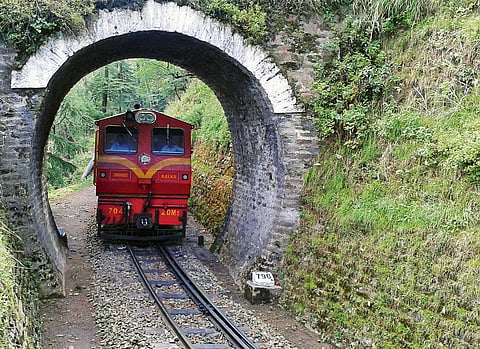

Often overshadowed by the more famous Kalka-Shimla toy train, the Kangra Valley Railway remains one of India’s most underrated mountain rail experiences. Stretching 164 kilometres from the plains of Punjab into the foothills of Himachal Pradesh, this historic narrow-gauge line offers a very different kind of Himalayan journey. Rather than disappearing into tunnels and winding sharply around mountainsides, the train follows a gentler route through the Kangra Valley, rewarding passengers with long, uninterrupted views of the surrounding landscape. The railway is also included on UNESCO’s tentative list of World Heritage sites.
The journey begins at Pathankot Junction in Punjab and passes through 33 stations before reaching its final stop at Joginder Nagar. Along the way, travellers encounter some of the region’s most significant cultural and natural landmarks. At Jawalamukhi Road, pilgrims disembark for the revered Jwalaji Temple, known for its eternal flame. Further ahead, the stations of Kangra and Kangra Mandir provide access to the historic Kangra Fort and the Brajeshwari Devi Temple, while also serving as a gateway to Dharamshala and McLeod Ganj
As the train climbs deeper into Himachal Pradesh, the scenery changes noticeably. Palampur Himachal opens onto rolling tea estates framed by pine and deodar forests, while Baijnath Paprola is known for the 13th-century Baijnath Shiva Temple — an impressive example of North Indian Nagara architecture. At Ahju, the highest point on the route at 1,290 metres, passengers are closest to Bir-Billing, renowned for paragliding.
One of the railway’s greatest attractions is its constant view of the Dhauladhar range. Unlike many mountain railways where tunnels and steep bends frequently interrupt the scenery, the Kangra Valley Railway meanders through an open valley, allowing the snow-capped peaks to remain visible for much of the journey. Travellers heading from Pathankot towards Joginder Nagar are often advised to choose a seat on the left-hand side for the best mountain vistas. The train crosses more than 900 bridges and viaducts spanning rivers, gorges and mountain clefts, including crossings over the Beas River. Perhaps the railway’s greatest charm lies in its unhurried pace. Taking around 10 hours to complete the full route, it offers an authentic glimpse into everyday Himalayan life. With basic vintage coaches and a notably affordable fare, often around `40 for the entire journey.
