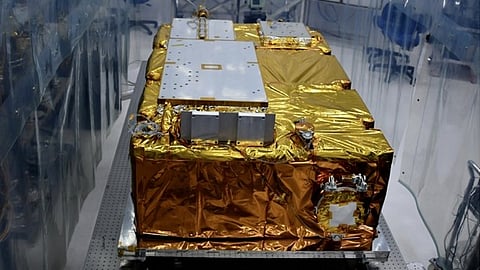

BENGALURU: The Visible Emission Line Coronagraph (VELC) - the primary scientific payload onboard Aditya-L1 designed and built by the Indian Institute of Astrophysics (IIA), Bengaluru may have provided solar physicists with a breakthrough in understanding the Sun’s mysterious energy budget.
Aditya-L1 is the first space-based observatory class Indian solar mission to study the Sun launched by the Indian Space Research Organisation (ISRO) on September 2, 2023. VELC onboard Aditya-L1 is an internally occulted coronagraph to conduct uninterrupted, simultaneous imaging, spectroscopy, and spectropolarimetry of the Sun's corona from its observation point at the Sun-Earth L1 Lagrange point.
The Sun’s surface is about 5500 degrees Centigrade but it’s corona can reach approximately two million degrees Centigrade and can go up to 40 million degrees Centigrade during eruptions. Why the outer atmosphere is hotter than the surface remains a mystery. Aditya-L1 is helping scientists investigate it.
"The shine of the Sun that we see every day is due to the continuous generation of energy in the interior of the Sun, which is transported outwards. So, it's natural to expect that the Sun’s temperature should decrease from the surface to the outer layers in its atmosphere. But in reality, it is not true. The mechanism behind this solar phenomenon continuously maintains the energy budget in the Sun’s atmosphere despite the occurrence of eruptions like the flares and coronal mass ejections (CME) during which large amounts of energy are released by the Sun,” said Senior Professor, Indian Institute of Astrophysics (IIA) and Principal
Investigator, VELC, Dr R Ramesh. He explained that these transient events, which are explosive in nature, are closely associated with sunspot regions. An active sunspot loses about one Watt Of energy per second per square centimetre, while a typical sunspot covers nearly 30 trillion square centimeters.
Since several CMEs can occur on a single day, the the Sun would lose enormous amounts of energy if that loss was not continuously replenished.
Using VELC data, IIA scientists found clear evidence that localised interactions between the tangled magnetic fields in the Sun’s atmosphere are the primary mechanisms replenishing energy lost during CMEs. “The higher temperature in the corona as compared to the solar surface is also due to similar interactions. The results obtained clearly indicate that though the waves generated as a result of the bubbling, boiling motions on the Sun’s surface also generate and transport energy, their contribution is very less. The wave motions supply only seven per cent of the energy requirement,” explained Ramesh.
“The data collected by VELC provide an important benchmark for future studies considering that both waves and magnetic reconnections are widely believed as the potential energy generation mechanisms in the Sun’s atmosphere. One of the key inputs for the study came from data obtained with the network of identical low-cost solar radio spectrographs, installed in several countries across the globe.
One such radio spectrograph is operated by the IIA in the Gauribidanur observatory near Bengaluru,” he added.
Dr V Muthupriyal, project scientist for VELC, said that it’s continuous and uninterrupted observations are proving invaluable to solar physicists worldwide, since energetic eruptions in the Sun’s atmosphere can occur any time.
