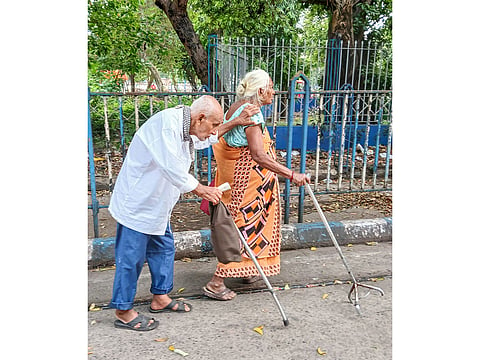

For the last 2 months, 78-year-old Latha (name changed), has been struggling with progressive slowness of walking and fear of falling. Three weeks prior, she had suffered an accidental slip that caused her to land on the floor, following which she developed increased apprehension while walking and reduced confidence in walking independently without any support or assistance.
When Dr Ashish Rajan, consultant geriatrician at Lisie Hospital, Kochi, examined her, he noticed there was no history of loss of consciousness, head injury, or preceding dizziness. “Her vital signs were stable. Geriatric assessment revealed gait slowing (walking speed), impaired balance, and reduced functional mobility. Examinations showed neither significant deformity or focal tenderness nor evidence of bony fracture or acute injury,” said Dr Rajan
She was then referred to the physical medicine and rehabilitation department, where she underwent a structured gait and balance training programme, including strengthening exercises, balance retraining, transfer training, and fall-prevention strategies.
While some decline in mobility is a natural part of ageing, experts believe that early intervention through exercise, disease control and fall prevention can help older adults remain independent for longer.
Talking about Latha, Dr Ashish said during follow-ups she showed significant improvement in walking speed, confidence, and balance, with reduced fear of falling.
“Usually several functional domains — cognition, food digestion, vision, and walking — will be affected as a person ages. Ageing will alter and diminish the ability to walk straight. Mostly, elderly people walk slowly, and it is normal. A major reason is the degeneration of the muscles and bones, changes in our reflex timings, latency in muscle actions, deficiencies, etc.,” said Dr Jino Joy, geriatrician at Medical Trust Hospital, Kochi.
A gradual reduction in walking speed is part of normal ageing, however, in older adults, it may also indicate underlying health problems and reduced physiological reserve. “Age-related changes such as sarcopenia (loss of muscle mass and strength), degenerative joint changes, and impaired balance contribute to slower walking. Neurological conditions, including stroke, Parkinson’s and reduced peripheral sensations (e.g. diabetic neuropathy), can affect gait and balance. Medication-related effects (including antihypertensive medications causing postural blood pressure reduction and sedatives) can further affect mobility and cause an increased risk of falls. Cardiovascular causes such as orthostatic hypotension, arrhythmias, heart failure, valvular heart disease, and coronary artery disease may reduce exercise tolerance and contribute to gait slowing,” said Dr Ashish.
He added that a comprehensive geriatric assessment helps to identify reversible causes, enabling targeted interventions, including exercise-based rehabilitation, balance training, and fall prevention strategies.
Scientific evidence and studies suggest that older adults unconsciously modify the way they walk to reduce the risk of falls.
Recently, a study led by Flinders University and the University of Canberra revealed that the body adopts a “safety-first” walking style during ageing that prioritises stability at the cost of speed and energy efficiency. Nearly 107 healthy adults aged 26 to 86 were identified as having subtle but important changes in how the ankle and surrounding muscles control each step.
As for interventions, investing in mobility at the earliest can help in preventing age-related slow walking. Dr Jino says that healthy ageing should be promoted. “If a person is in their 40s and 50s and wants to invest in mobility, what they have to do is routine strengthening exercises, not just aerobic exercises, walking or swimming. We need strengthening exercises, grip exercises for muscles, and physiotherapy, considering the requirements of the patient,” he said, adding that once the degeneration happens and nerves are down, the condition won’t be reversible.
“Gait was something we tended to overlook in the past. Today, people are much more aware of its importance, especially as they age. Healthy ageing should not begin at 60, ideally, it should start in the 40s or even earlier. Several hospitals have been launching longevity clinics, which focus on preventing disease and optimising long-term health. Conditions such as diabetes, hypertension, and obesity can have significant effects on mobility and overall function later in life. The earlier we address these risk factors, the better our chances of maintaining independence and quality of life in older age,” said Dr Jino, adding that healthy lifestyle practices should be followed.
Experts also recommend the timely use of assistive devices such as walking sticks and walkers when required, as they can improve safety and confidence. “Falls should be prevented whenever possible, as they are a major cause of morbidity in older adults. A fall, especially when associated with injury or fracture, can lead to pain, fear of falling, reduced physical activity, loss of confidence, and restriction of mobility. This may result in a cycle of functional decline, muscle deconditioning, increased frailty, and further risk of falls,” added Dr Ashish.
