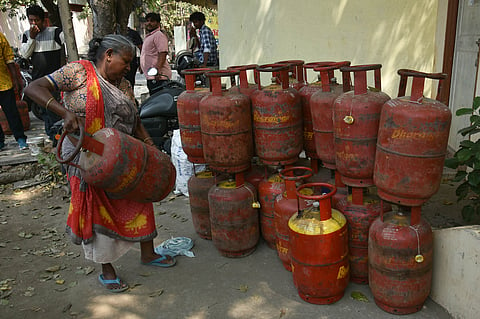

India’s rapid transition to cleaner cooking fuels over the past decade has significantly increased the country’s dependence on imported energy, raising concerns about price volatility, supply disruptions and long-term energy security, according to recent analyses by the International Institute for Sustainable Development (IISD) and Global Energy Monitor (GEM).
India’s consumption of liquefied petroleum gas (LPG), the primary cooking fuel for most households, has doubled from around 15 million metric tonne (MMT) in 2011-12 to nearly 31 MMT in 2024-25, reflecting a major shift away from traditional biomass fuels. However, the majority of this growth has been met through imports. Imported LPG rose from about 6 MMT to around 21 MMT during the same period, accounting for more than 93 per cent of the increase in consumption, according to the IISD briefing.
Experts warn that such heavy reliance on imported fuels exposes India to economic and geopolitical shocks. Recent developments in West Asia, including including disruptions linked to tensions involving Iran and shipping routes through the Strait of Hormuz, have highlighted the vulnerability of energy-importing countries to global supply disturbances.
“India’s high reliance on imported fuels to meet growing demand increases exposure to economic, energy, and health risks,” the IISD analysis notes.
Import risks and price shocks
Global fuel markets have already shown how volatile such dependencies can be. The ongoing conflict in West Asia has disrupted shipping in key energy corridors and triggered price spikes in global fuel markets. A separate report by Global Energy Monitor notes that energy shocks tied to tensions around Iran demonstrate how quickly supply disruptions can tighten access and raise costs for countries dependent on imported gas.

Southern Asia, particularly India, Bangladesh and Pakistan, is planning a massive expansion of liquefied natural gas (LNG) infrastructure worth about $107 billion, including terminals and pipelines aimed at increasing gas consumption.
The region already accounts for 17% of global LNG import capacity currently under development, or about 110.7 million tonne per annum, along with 17% of gas pipelines planned globally, totalling about 34,146 km.
India alone has 84.6 million tonne per annum of LNG import capacity planned and is building 19,635 km of gas pipelines, the third-largest planned pipeline expansion in the world after China and Russia.
Robert Rozansky, global LNG analyst at Global Energy Monitor, said the region’s reliance on imported fuels leaves it highly vulnerable to market disruptions.
“We’ve seen this story before, and South Asian economies that import LNG will struggle with these price shocks. It’s a reminder of the risks of building new gas infrastructure, and that domestic alternatives like renewable power are more affordable and reliable in the long run,” he said.
Clean cooking transition under pressure
India’s clean cooking transition has been driven largely by the expansion of LPG access, including government initiatives such as the Pradhan Mantri Ujjwala Yojana (PMUY), which provided subsidised LPG connections to millions of low-income households.
But experts say the strategy of relying mainly on LPG and piped natural gas (PNG) could become increasingly difficult to sustain if global prices remain volatile.
India is planning a major expansion of PNG connections to 120 million households by 2030, nearly eight times the current level. Meeting this target would likely require a substantial increase in natural gas imports, potentially deepening the country’s dependence on external fuel supplies.
High import dependence also exposes India to fluctuations in global prices. If international energy prices rise sharply, the government may face increasing subsidy burdens or households could see higher cooking costs.
Price volatility also carries health risks. If LPG becomes unaffordable, poorer households may revert to traditional biomass fuels such as firewood or charcoal, which are linked to severe indoor air pollution and respiratory illnesses.
Electric cooking seen as cheaper alternative
Energy experts say diversifying cooking energy sources could reduce these vulnerabilities while sustaining progress on clean cooking. Sunil Mani, policy advisor at IISD, said electric cooking is already becoming cost-competitive compared with LPG.
“Recent reports of LPG shortages for commercial users highlight rising pressure on India’s cooking fuel supply and the risks of relying heavily on imports. While prioritising LPG for households can provide short-term relief, it also reinforces the need to diversify clean cooking options,” he said.
“Our latest analysis shows that electric cooking was already about 15% cheaper than LPG. With the recent `60 price increase for a 14.2 kg cylinder, electric cooking is now roughly 20% cheaper for many households,” he added. Encouraging urban households with reliable electricity to shift to electric cooking can reduce cooking costs and ease demand for LPG, he added. “This would help ensure that LPG supply is maintained for lower-income households supported through schemes such as the PMUY,” Mani said.
According to IISD estimates, gradually scaling up electric cooking could reduce LPG demand by up to 50% by 2050, strengthening India’s energy security while supporting the country’s clean cooking transition.
The shift toward electrification of cooking could also align with India’s rapidly expanding renewable energy sector. Renewables already account for around 40% of India’s installed power capacity, and the country is projected to meet more than 40% of its electricity demand through renewable sources by 2030, according to the GEM briefing.