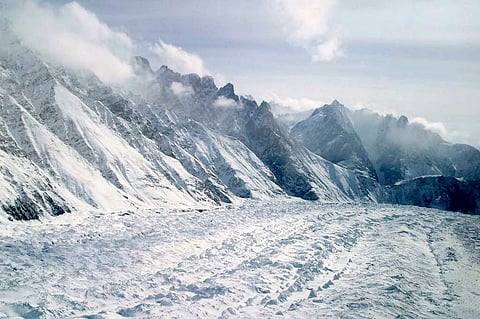

Himalayan glaciers are melting at an accelerated rate, raising alarm for India’s major river basins — Indus, Ganga and Brahmaputra — which support over 650 million people.
These basins contain over 74 per cent of the total number and area of glaciers in the Hindu Kush Himalaya (HKH), one of the world’s largest natural water reserves.
A latest report on HKH glaciers highlights the rapid rate of loss over the past three decades, which may severely impact seasonal water availability and long-term flows into these river systems. The water from these glaciers acts as a buffer against drought, influences hydropower generation and shapes the resilience of downstream agriculture and economies. The report, titled ‘Changing Dynamics of Glaciers in the Hindu Kush Himalaya Region from 1990 to 2020’, notes that these river basins have experienced the largest absolute area losses, underscoring their critical vulnerability.
The study was prepared by the International Centre for Integrated Mountain Development (ICIMOD), an intergovernmental agency based in Kathmandu dedicated to conserving mountain ecosystems.

The HKH region is home to over 63,700 glaciers, covering nearly 55,782 sq km and storing around 5,736 cubic km of ice reserves, based on 2020 Landsat satellite imagery.
The study notes that glacier loss in the HKH is widespread and accelerating, threatening the sources of at least ten major Asian river systems that collectively support the food, water, energy and livelihood security of about 2 billion people. It also increases the risk of glacial lake outburst floods (GLOFs). Between 1990 and 2020, HKH glaciers lost about 12% of their total area and 9% of their ice reserves. The report adds that limited monitoring hampers intergovernmental cooperation and the development of holistic conservation policies, especially given the accelerating rate of glacier loss.
Melting trends
The study categorises glaciers into two types — those less than 0.5 sq km (smaller glaciers) and those exceeding 10 sq km (larger glaciers). Smaller glaciers, though more numerous, cover less area and are shrinking faster, especially those facing east and southeast and located on steeper slopes. This poses an immediate risk of localised water shortages and intensifying hazards.
In contrast, larger glaciers are more susceptible to long-term shrinkage due to the ongoing climate crisis.
The heavily glaciated Karakoram range, which contains 18 of the 25 largest glaciers in the region, remains vulnerable to long-term risks affecting water, food, energy and livelihoods, with wider regional implications. Observations indicate that glacier losses are concentrated below 6,000 metres above sea level across all major river basins and sub-ranges, affecting both seasonal water availability and long-term river flows.
Additionally, glacier losses are spatially concentrated in the southern and eastern parts of the region. The Hengduan Shan and parts of the eastern Tibetan mountains have recorded the highest percentage losses, with some areas losing up to 33% of glacier area in just three decades. Conversely, the highest concentration of total glacier area loss is observed in the central and western Himalayas and the Nyainqêntanglha range.
Limited monitoring
Human-induced climate change has significantly impacted HKH glaciers. Many are losing mass at increasing rates, altering runoff patterns and contributing to the expansion of glacial lakes, which in turn heightens GLOF risks and threatens long-term water stability. Although countries have begun monitoring glacier changes, coverage remains limited, posing challenges for the region.
The first glacier-wide field measurements in India were conducted in 1974 on the Gara Glacier in Himachal Pradesh by the Geological Survey of India, laying the foundation for understanding glacier–climate interactions. With advances in satellite technology and remote sensing, monitoring expanded through national programmes and international collaborations.
However, ICIMOD scientists note that large parts of HKH glaciers remain unmonitored. To date, only 38 glaciers have been observed out of approximately 63,700. These observations are unevenly distributed, underscoring the need for sustained investment and coordinated regional strategies.
Losing thickness
Recent observations show that most Himalayan glaciers are experiencing a negative mass balance, meaning they are shrinking over time. Glacier mass balance remains a key scientific indicator. Analysis shows that mean mass loss has nearly doubled from the pre-2000 period (1974–1999) to the post-2000 period (2000–2023), indicating a sharp decline in glacier storage. Annual mass loss has intensified to about 9 cm of water equivalent per decade.
Since September 1974, a total of 302 annual glacier-wide mass balance measurements have been recorded across 38 glaciers. Of these, only 32 years (11%) showed positive mass balance, while 270 years (89%) recorded negative mass balance.
Of the 38 glaciers studied, 17 measurement series have been discontinued, with some lasting only 10 to 12 years. This has led to uneven data distribution and methodological inconsistencies. Currently, 19 series remain active, including Batal, Bara Shigri, Chhota Shigri, Drang Drung, Gangju La, Gepang Gath, Hoksar, Khardung, Mera, Pensilungpa, Phuche, Pokalde, Rikha Samba, Sutri Dhaka, Samudra Tapu, Thana, Trambau, West Changri Nup and Yala. Two glaciers — Kolahoi and Naradu — have recently been brought back under observation.