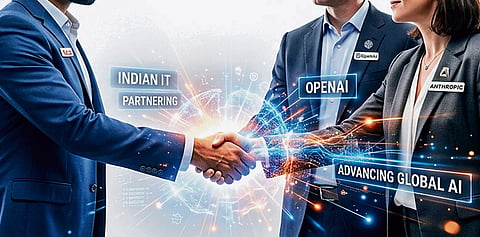

India’s technology services industry is entering one of its biggest transitions in decades. Over the past couple of months, major IT firms including Infosys, TCS, Wipro, HCLTech and Tech Mahindra have announced partnerships with artificial intelligence firms including OpenAI and Anthropic. On the surface, these deals sound technical and corporate; but underneath, they reflect a much larger change taking place across the global technology industry.
For years, Indian IT firms made money by helping large corporations manage software, maintain systems and reduce operational costs. Banks, retailers and manufacturers across the world outsourced technology work to India because it was cheaper and scalable.
Artificial intelligence is beginning to change that model. Tools built by OpenAI and Anthropic can now write code, generate reports, automate customer support and assist with software testing. Work that once needed large teams of engineers can increasingly be done faster with AI systems. That creates both an opportunity and a threat for India’s outsourcing industry.
The partnerships are largely about survival and positioning. OpenAI and Anthropic build the underlying AI models, but large companies still need help deploying them. Most businesses cannot simply plug an AI chatbot into their operations overnight. They need security checks, compliance approvals, customised software integration and employee training.
This is where Indian IT firms still have an advantage. They already manage technology systems for some of the world’s largest corporations. They understand how enterprise infrastructure works and have thousands of engineers working directly with clients.
In simple terms, AI firms build the engines, while Indian IT companies help install and operate them inside corporations. That is why these alliances are growing rapidly.
Infosys and TCS have both expanded enterprise AI work with global model providers, while Wipro and HCLTech have launched AI-focused consulting and deployment services. Similar partnerships are also being pursued globally by companies such as Accenture and PwC.
The bigger concern inside the industry is that AI could eventually reduce the need for large engineering teams.
For decades, Indian IT companies grew by increasing headcount. More engineers often meant more revenue. Generative AI challenges that logic.
If 10 engineers using AI tools can do the work that previously required fifty, the economics of outsourcing begin to shift.
Industry leaders are publicly describing AI as a growth opportunity, but many also understand the long-term risks.
Venture capitalist Chamath Palihapitiya recently warned consulting firms about becoming too dependent on AI companies. “If you are running a consulting business and you are deploying Anthropic or OpenAI directly into your organisation... you are letting the fox into the hen house,” he wrote on X.
His argument reflects a growing fear that AI companies may eventually move deeper into enterprise services themselves, potentially competing with the consulting firms currently helping them expand.
Still, Indian IT companies are not disappearing anytime soon. Large banks, governments and healthcare firms cannot easily replace critical systems with experimental AI tools. They still need human oversight, cybersecurity, compliance and integration support.
Many are now retraining employees in AI skills while trying to shift towards higher-value consulting work instead of labour heavy outsourcing alone.
