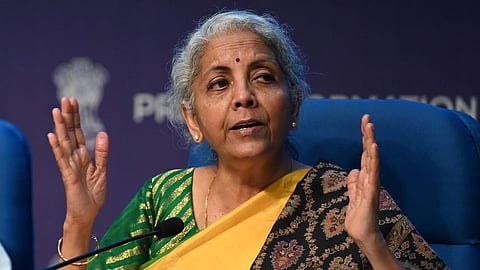

Finance Minister Nirmala Sitharaman in her budget speech on July 22 seemed fully seizes of India's jobs problem.
As one of our columnists Praveen Chakravarty noted, she mentioned the word 'employment' 24 times in her budget speech. She also set aside a whopping Rs 2 lakh crore for employment and skilling schemes over the next five years to apparently skill and provide jobs to 4 crore young Indians.
Two of the big ideas she announced for job creation -- an employment-linked incentive (ELI) scheme and an internship scheme -- were like Chakravarty noted borrowed from the Congress manifesto.
Chakravarty, in his column for The New Indian Express, lauded "the bipartisan consensus on a critical national issue like employment is laudable and much needed".
But according to him, "bombast aside, the budget annexure outlines convoluted and complex details of these schemes that seem designed to scare corporates away rather than lure them to create jobs".
One of our other experts, Anil K Sood, also was not convinced by the schemes and raised some essential questions in his column.
Here's what he wrote:
Employment Linked Schemes: Are they solving the employment level or the quality of employment problem or none?
Based on the description provided in the budget document, it is hard to believe that the schemes will solve the employment problem. For example, Scheme A pays Rs 15,000 per annum, in three instalments, to an employee who retains his or her job for 12 months and undergoes a compulsory online Financial Literacy course.
Why do we need to provide financial support to someone who has just got a job and why do we force financial literacy programme to people who are likely to have not more than the basic level of education?
Another question is:
Which trades or professions does an employee take for a year to be fully productive? If it does, should we not invest in accelerating capability building and not throw money for improving financial literacy?
Also, what is the rationale of fixing the upper limit of one lakh per month?
The document claims that it will help one crore persons per annum. How would that happen when the Survey mentions that we need only about 80 lakh jobs per year?
Are we creating an administrative nightmare or an opportunity to steal as all the schemes have provisions for withdrawal of subsidy or thresholds for eligibility?
I also notice an obsession with having EPF enrolment. Why do we need to do that for low-income employees? Why not just the ESI enrolment so that these families get a healthcare coverage too?
Finally, how likely is it that the employers will create additional jobs for subsidies that range from Rs 3,000 to Rs 36,000 per year?
All valid questions. Can the Finance Minister answer them?
