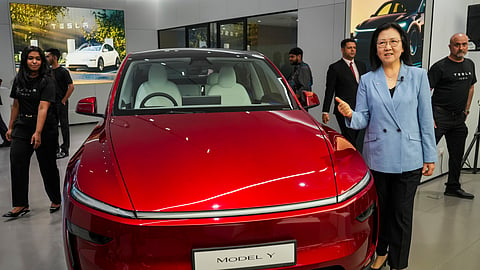

Tesla's entry into the Indian market is unlikely to disrupt the existing electric passenger vehicle (PV) segment in the near term, but the American automaker has strong potential to emerge as a key player in the coming years.
"While the premium electric car segment remains niche, it is growing rapidly, driven by India's rising millionaire population and their appetite for high-tech vehicles," said Puneet Gupta, Director of India & ASEAN Auto Market at S&P Global Mobility.
Industry data shows luxury EV sales surged 66% year-on-year between January and May 2025. These vehicles now account for 11% of total luxury car sales, up from 7% in the same period last year.
Gupta suggests Tesla could explore setting up a manufacturing plant in India within 2-3 years, as rising passenger vehicle exports and shifting domestic demand may incentivize the automaker to develop India-specific models.
He also highlighted the timing of Tesla's strategy to initially sell cars as completely built units (CBUs) and potential benefits from ongoing India-US trade negotiations. "If the trade agreement reduces import taxes on American cars, Tesla could see a major price advantage, boosting its sales significantly," Gupta added.
Vinay Raghunath, Partner, Automotive and Mobility Sector Leader at EY India, said that while the initial impact of Tesla’s entry may be more symbolic, it will undoubtedly elevate consumer awareness, spark greater interest in EVs and set new benchmarks in connected and autonomous mobility.
“This move will also encourage OEMs and ecosystem players to step up innovation and accelerate investments in EV infrastructure and technology,” added Raghunath.
Despite the excitement generated by its entry, marked by the opening of a flagship showroom in Mumbai, Tesla's sales in India are expected to remain modest in the near term. The automaker currently offers only one model and has limited expansion plans for the market. Additionally, its premium pricing, nearly twice as high as in some other markets, will restrict its appeal to a niche segment of affluent buyers.
The company has launched its most popular model, Model Y (RWD), in India at a starting price of Rs 60 lakh that goes up to Rs 68 lakh for the long range variant. India prices are significantly higher than in other markets as prices for Model Y start at Rs 38.6 lakh ($44,990) in the US, Rs 30.5 lakh in China (263,500 yuan), and Rs 46 lakh in Germany (€45,970).
The higher prices in India are attributed to import duties and logistics costs. India imposes a 70% tariff on imported cars priced below $40,000. With this pricing, Tesla will compete against other imported luxury cars such as Kia EV6, BYD Sealion, Hyundai Ioniq 5, BMW iX1 and Mercedes-Benz EQA.
Tesla’s premium pricing will make its vehicles unaffordable for over 95% of car buyers in India -- the world’s third-largest automobile market by volume. Currently, India’s EV adoption is being driven by more affordable options priced below Rs 20 lakh, including Tata Motors’ Nexon EV and Punch EV, along with JSW MG Motor’s Windsor EV.
