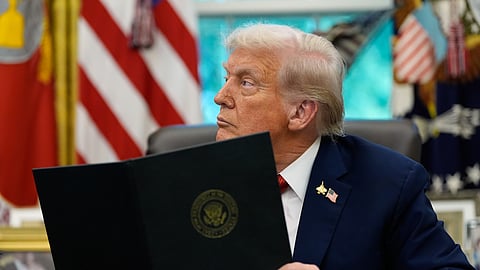

US President Donald Trump announced on Friday that his administration will impose a 100% tariff on branded and patented pharmaceuticals starting October 1, 2025, unless companies set up production in the US. The move directly impacts India’s pharmaceutical sector, particularly large drug makers increasingly focused on complex generics and biologics, which largely fall under the branded or patented category.
Indian pharmaceutical companies are increasingly focusing on complex generics, which are harder to replicate due to their sophisticated formulations or delivery mechanisms. This shift is aimed at accessing higher-value markets and reducing reliance on traditional generics. Firms such as Sun Pharmaceuticals, Dr. Reddy's Laboratories, Biocon, Aurobindo Pharma, Glenmark and Lupin have been expanding their portfolios of complex generics, particularly for regulated markets like the US.
Overall, India supplies more than half of the world’s vaccines, 40% of generic drugs in the US. Its total pharmaceutical exports hit a record USD 30 billion in FY25, driven by a 31% year-on-year surge in March.
Notably, data from the union government showed that India’s drug and pharmaceutical exports rose 6.9% to USD 2.51 billion in August 2025 from USD 2.35 billion a year earlier.
In FY24, pharmaceutical exports totalled USD 27.9 billion, with the US accounting for 31% — about USD 8.7 billion (Rs 77,231 crore), Pharmexcil data showed. In the first half of 2025, shipments worth USD 3.7 billion (around Rs 32,505 crore) were dispatched overseas.
Leading companies such as Dr. Reddy's, Aurobindo Pharma, Zydus Lifesciences, Sun Pharma and Gland Pharma derive between 30-50% of their overall revenues from the American market.
According to a government report, India's pharmaceutical industry is a global powerhouse, ranking third in the world by volume and 14th in terms of production value. It supplies over 50% of global vaccine demand and nearly 40% of generics to the US. The industry is projected to grow to USD 130 billion by 2030 and USD 450 billion market by 2047.
Backed by policy support for pharmaceuticals, such as the PLI scheme (Rs. 15,000 crore) and the Strengthening of Pharmaceuticals Industry (SPI) scheme (Rs. 500 crore), the industry continues to expand its global footprint. The PLI scheme is driving investments into 55 projects to make high-end drugs such as cancer and diabetes medicines in India, while the SPI scheme, that focuses on raising the quality, competitiveness, and resilience of smaller pharma companies, is funding R&D and modernizing labs, enabling Indian companies to compete globally.
Beyond cost efficiency, India has emerged as a hub for affordable, high-quality medicines, reinforcing its rightful title as the "Pharmacy of the World," the report said.
Earlier, in a post on Truth Social, Trump wrote, "Starting October 1st, 2025, we will be imposing a 100% Tariff on any branded or patented Pharmaceutical Product, unless a Company IS BUILDING their Pharmaceutical Manufacturing Plant in America. 'IS BUILDING' will be defined as 'breaking ground' and/or 'under construction.'"
Clarifying the scope of the measure, Trump added that companies that have already begun construction of plants in the US will be exempt from the new tariff. "There will, therefore, be no Tariff on these Pharmaceutical Products if construction has started. Thank you for your attention to this matter!" the post read.
The US President further announced sweeping tariffs on various household products, including imported kitchen cabinets and certain types of furniture, potentially adding even more costs to a category that has surged in price in recent months.
"We will be imposing a 50% Tariff on all Kitchen Cabinets, Bathroom Vanities, and associated products, starting October 1st, 2025. Additionally, we will be charging a 30% Tariff on Upholstered Furniture," he wrote.
