
The ongoing West Asia conflict and its lingering effects are threatening to derail India’s civil aviation growth story. A sharp surge in oil prices, frequent airspace closure in the Gulf region, mass cancellations on busy routes and depreciation of the rupee are likely to weigh on airlines’ revenue and operating market in the short term.
Sunny Agrawal, Head - Fundamental Research at SBI Securities, told TNIE that frequent airspace closure in West Asia is impacting the international operations of Indian carriers which is adding to the disruption due to the closure of Pakistani airspace.
He added that Indian carriers have to take longer routes to fly to several destinations in Central Asia and Europe leading to a loss of market share to European carriers such as Lufthansa. Besides, the Middle East itself accounts for the majority of India's international traffic.
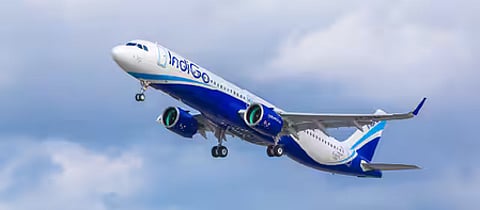
“Middle East accounts for 35-40% of IndiGo's international capacity and 20% of IndiGo's total capacity. The extent of impact on revenue will depend on how long the crisis lasts. Margins in Q4 are likely to get impacted by multiple factors: higher ATF prices, rupee depreciation, negative operating leverage due to curtailment of international capacity,” stated Agrawal. He added that domestic routes where Indigo has a monopoly could see an increase in airfares especially on many Metro to Tier 1/2 city routes.
Rising oil prices lead to higher jet fuel prices while a depreciating rupee leads to higher operational costs as the lease payments for aircraft are denominated in USD besides the salaries to foreign pilots.
The average price of jet fuel in 11 months until February 2026 stood at Rs 91,173 per kiloliter (KL), but in March 2026 it increased by 6% to reach Rs 96,638 per kl. The rupee, meanwhile, hit a record low of 92.3475 against the US dollar on Monday (March 9) owing to a sharp surge in crude oil prices.
In recent sessions, Brent crude spiked to $119/barrel post the continued closure of the Strait of Hormuz amid the ongoing war between the US-Israel coalition and Iran. On Tuesday, oil prices were in the range of $93-95/barrel.
Shobit Singhal, Research Analyst, Anand Rathi Institutional Equities, said that 15% of the total capacity deployed (ASK) by IndiGo is towards the Middle East and Africa (MEA) region. “Given that Dubai and Doha serve as major international aviation hubs for connecting flights across the West, disruption in these markets will have a cascading impact on overall international travel demand not just the MEA region,” added Singhal.
The airspace closure across West Asia has resulted in about 2,600 flight cancellations for Indian airlines between February 28 and March 8. This is roughly 45% of their total international flights. Rating agency ICRA believes Indian airlines could report a higher-than-previously estimated net loss of Rs 17,000-18,000 crore in FY26.
Crisil in a statement said that due to airspace restrictions over the Middle East, flights by Indian carriers to and from Europe and the US will incur higher fuel costs as diversions and detours add to flying time.
“An increase in crude oil prices will impact operating margins given the limited ability of airlines to pass on, especially on domestic routes. Further, any sharp depreciation in the rupee will also have a bearing on the profitability of Indian airlines as a significant portion of their lease liabilities is in foreign currency,” added Crisil.
