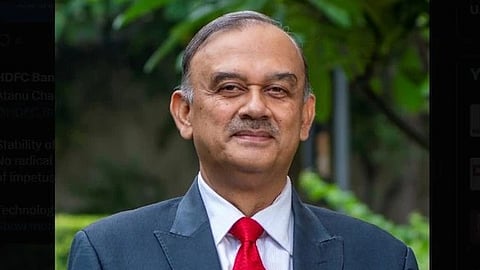

HDFC Bank's recent top-level exit evokes a familiar feeling: When someone says there's nothing wrong and yet quits, something is definitely wrong.
In a sudden development, Atanu Chakraborty, a retired bureaucrat who was on the HDFC's board for five years, resigned as its part-time chairman and independent director, citing concerns over 'certain happenings and practices' not aligning with his personal values and ethics.
Giving the particulars in an unscheduled media interaction, the bank maintained that Chakraborty did not offer specifics and refused to take back his resignation despite repeated requests from ALL the board members totalling 12.
In separate, exclusive interactions with the media, Chakraborty himself noted there were no wrongdoings that forced him to quit. But despite clarifications from both sides, the gulf of incomprehension remains. Is it possible that someone's pitching a yarn either to throw the bank into a tailspin or to protect it from an unavoidable collapse?
Minutes after the resignation became public, markets felt a razor run through its wrists. As benchmark indices Sensex and Nifty bled, an estimated Rs 1 lakh crore in investor wealth evaporated in a few hours. Investors often price transparency, and disclosures higher and expect companies to narrate everything down to the wire, including that walk on the final bridge between life and death.
So on Thursday, the bank, with a hand to god, said all's well, while Chakraborty justified his exit saying it had nothing to do with ethics or governance issues. Still, the question persists as to why Chakraborty resorted to an extreme measure like quitting at a moment's notice?
Markets, analysts, investors were shaken, and rightfully so. To paraphrase the late PV Narasimha Rao's remarks, this bunch never rejects nothing useful for its plainness, and nothing irrelevant for its dazzle. The Thursday market crash, perhaps, was pointing out those underlying issues, or chances are HDFC's share price hitting a fresh 52-week low to Rs 770 was reflecting an unknown reality.
The bank's management, which can command enough credibility with one click, managed to set the plane down softly amid Thursday's stock market storm. Its hard-earned credibility also came in handy sinking fears of governance and ethical issues, if any, down to a whisper. That said, it'd be a folly to dismiss Chakraborty's resignation remarks as mere bureaucratic argle-bargle.
Clearly, Chakraborty isn't some petulant or miffed child who refuses to talk it out. He isn't an inexperienced bureaucrat committing a basic schoolboy error of quitting over an ego battle either. The bank did allude to 'personal relationship issues,' but urged media not to indulge in Humpty-Dumptyism. By the bank's own admission, the management, however, asked Chakraborty to tone down the language used in his resignation letter, but it's unclear if he obliged.
HDFC's old-guard Keki Mistry pitched in, dismissing speculation about internal conflicts and reasoning that there were no other ugly ferrets in a bag. "There was no material difference between Atanu and the board," he said, adding that directors were not given detailed reasons behind the ethical concerns.
Regardless of whether it's personal or not, the good news is, neither Chakraborty nor the bank is indulging in additional punches after the first fight. For now, at least. That's highly needed given the bank's stature as the country's largest private lender. The onus also lies with the banking regulator RBI, which needs to cast its audit and accounting searchlights wide and deep to find the wrecking ball, if any.
On its part, the central bank did act swiftly approving HDFC's arrangement of appointing Mistry as interim chairman for next three months, while deputy managing director Kaizad Bharucha will take on additional responsibilities. This, along with the bank's top brass' prompt media appearances to minimize the damage occupied the press and satisfied the public, momentarily. Yet concerns over internal practices, ethics and governance continue to twitch like a bad nerve, even if none can smell or touch it.
That's because, the watchword in Chakraborty's resignation dated March 15, are the developments he had observed over the past two years that formed the basis for his decision to step down. "Certain happenings and practices within the bank, that I have observed over the last two years, are not in congruence with my personal values and ethics," he said in the letter, adding that there were no other material reasons behind his resignation. The bank, in an official communication on March 18, confirmed the resignation and stated that there were no reasons beyond those cited in Chakraborty's letter.
Interestingly, Chakraborty's departure follows two years on the board, during which he oversaw a crucial phase in the bank's history, including its merger with HDFC Ltd, that created a financial conglomerate and positioned HDFC Bank as the second-largest lender in the country.
Which brings us to the question whether Chakraborty did not raise, discuss or argue his case with the board in those TWO full years? Or did the board dismiss his viewpoints each time turning it into a lonely crusade?
In a media interaction on Thursday, Chakraborty stressed that there was no wrongdoing. "I am not pointing out any wrongdoings at the bank. My ideologies did not match with the organisation," he said. If it's nothing serious, why didn't Chakraborty cite personal issues to quit instead of explicitly mentioning what he did and resign without even allowing the board a chance to reconcile or state its position?
The simple point is, there cannot be smoke without fire. What's unclear is if this is an existential fire or just a false alarm? In any case, we need a truth serum to avoid discovering discrepancies too late.
For now, analysts believe the stock selloff is overdone, as the bank's fundamentals remain strong with healthy return on assets. Brokerages also called the resignation non-material, noting continuity under CEO Jagdishan. They, however, urged both the bank and the regulator to issue detailed disclosures on the concerns behind the exit.
Officials at the Ministry of Finance too weighed in stating that the bank has strong fundamentals. Of course, there's no doubt about it. But it's also a fact that problems often start small. Until the bank issues detailed disclosures on Chakraborty's resignation, concerns about internal practices and ethical incongruence are akin to the philosophical question about The God Particle: "If the Universe is the Answer. What is the Question?"
