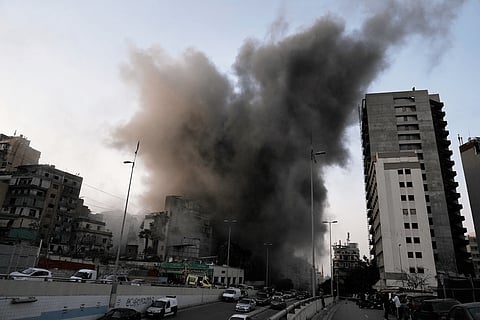

It's just week three of the war in West Asia, but the dreaded R word has already arrived.
According to Oxford Economics, if global oil prices average around $140 per barrel for two months, along with tighter financial market conditions, and heightened supply-chain disruptions, it would be enough to push parts of the global economy into a mild recession!
As it is, there are mild contractions in the Eurozone, the UK, and Japan, while the US nears a temporary standstill as layoffs push up the unemployment rate leaving it close to a recession, it added. But if prices average around $100 per barrel for two months, recessions would be avoided, though a growth slowdown may not be entirely prevented.
The war comes at the most heartless of moments for the global economy. We just had a moderately soul-shaking year, thanks to tariffs and though the trade-war related uncertainties aren't entirely resolved, they are, however, relegated to background chitchat for now. It's the war's structural shock that's upsetting the global economic order and the longer it runs, the more lasting the damage will be.
As for price rise, global central banks are tantalizingly close to their respective inflation targets, but as energy prices are flung by fate into undesirable territories, they have to brace for another chase on their hands.
The IMF believes that an annual 10% increase in energy prices would push global inflation by 40 bps and reduce growth by 0.1-0.2%. Likewise, the RBI in the past noted that a 10% increase in global crude prices could contemporaneously raise India's headline inflation by about 20 bps. The estimates seem relatively absorbable, but averages are often a trap.
Undeniably, households get scalped the most in an inflationary period and estimates conceal more than they reveal. Often, the cost of war doesn't count the quieter arithmetic of families paying more for food and fuel. Moreover, households suffer the price rise hangover headache for longer durations, while businesses wilt more than economic models tend to capture during slowdowns and recessions.
For India, the timing is exceptionally brutal. We are near the finish line, but rising oil prices have positioned the 4% inflation target straight in the firing line. Importantly, it prevents the Indian economy from making the most of the famed Goldilocks period where low inflation and high growth harmoniously get along like night and day.
Crude oil prices nearly doubled from less than $70 per barrel on February 27 to $120 before settling closer to $90 last Friday. Besides rising prices of oil and supply bottlenecks, LPG shortages and price increases are forcing countries to adopt extreme measures. Indian restaurants are already warning of possible shutdowns, while Thailand has urged civil servants to take stairs instead of elevators. The Philippines introduced a temporary four-day work week for some government agencies, while Vietnam is encouraging people to work from home.
Predictably, markets are getting ratty with every decimal point change in oil prices. Even as India attempts to duck and dodge along with everyone else, the war and the Middle East conflict sent bulls underground, wiping out an estimated Rs 33 lakh crore worth market capitalisation in just one fortnight.
The Gulf economies account for only 2-3% of global GDP, which means, even a severe regional downturn should have a limited impact on world output. For instance, during the 12-day war last June, Israel's economy contracted by 1% in Q2, according to the OECD, though the rest of the world didn't feel the pinch. However, a prolonged conflict now will translate to a direct and deeper impact on both Israel and Iran.
What's worrying economists is how this war can indirectly have the global economy in a chokehold. It's the cascading economic fallout that could radiate beyond the Gulf, disrupting market access and supply chains, particularly, for import-dependent Asian economies. And even though the oil price shock is global, the pain gets unevenly distributed, again among Asian countries.
According to the World Economic Forum (WEF), the US imports relatively little oil through Hormuz, so its Asian peers bear an overwhelming share of the burden that's been created. More than 80% of oil and LNG shipped through the strait in 2024 went to Asian markets, with China, India, Japan and South Korea being the primary destinations. Japan relies on the Middle East for about 90% of its crude oil imports, most of which passes through Hormuz. South Korea gets about 70% of its crude from the Middle East, and routes more than 95% of that through Hormuz. LNG prices in Asia have surged, and South Korea has already moved to activate a $68 billion market-stabilization programme in response to war-reated volatility.
Apart from oil supplies, trade from the Middle East has significant ramifications too. For instance, Qatar produces about 40% of the world's helium, which is used in the production of semiconductor chips. It also produces ammonia and nitrogen, key ingredients in many synthetic fertilizer products. The conflict is driving up energy and fertilizer prices, which could threaten food security and will be evident in the coming weeks.
As the World Economic Forum noted, the energy disruption is the only visible layer. The ripple effects have stretched from semiconductor fabs in Taiwan, China, to farms in Brazil and steel mills in South Korea. The fertilizer shock is potentially more devastating, as the Gulf is a major artery for urea, ammonia, sulfur, and other fertilizer inputs, and conflict-related disruption has already tightened supply. Urea prices shot up by 30% over the past month, while soybean oil prices hit their highest level in over two years. It concluded that every additional week of disruption makes recovery harder and expensive.
Historically, every major oil shock has generated a policy response proportional to the pain it inflicts. If the 1973 oil embargo accelerated France's nuclear programme, the 1979 Iranian revolution drove Japan's aggressive energy-efficiency push. India, with thinner reserves, stands vulnerable to a prolonged disruption as higher prices feed directly into everyday expenses of individuals and businesses. Above all, it'll test RBI's resolve to fight the inflation monster without affecting growth.
