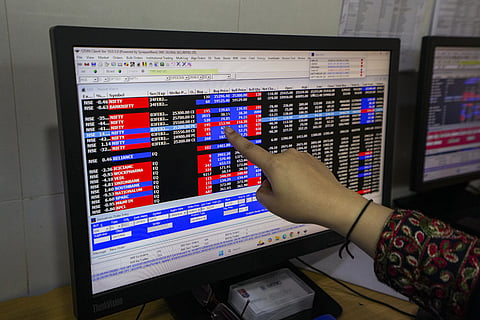

The stock market benchmark—BSE Sensex—slipped below 75,000 on Friday amid panic selling fueled by escalating West Asia tensions and surging crude oil prices.
Over the past two weeks (or roughly 10 trading sessions), investors have lost nearly Rs 39 lakh crore in wealth, with BSE-listed firms' market capitalization tumbling from Rs 468.28 lakh crore to Rs 429.39 lakh crore.
During this period, the Sensex has shed nearly 7,700 points while the Nifty50 has fallen about 2,345 points.
On Friday (March 13), the markets were again in freefall and at close, the Sensex declined 1,470.50 points or 1.93% to settle at 74,563.92, while the Nifty declined 488.05 points or 2.06% to 23,151.10.
Both the indices—Sensex and Nifty50—declined more than 5% this week, marking their steepest weekly fall in nearly four years. Even in March so far, Nifty has fallen by 8%, the worst monthly fall since the pandemic fall of March 2020. This relentless selling has pulled down indices to fresh 11 month lows with the BSE-listed firms losing Rs 20 lakh crore in market capitalization in just five sessions.
Tanvi Kanchan, Associate Director at Anand Rathi Share and Stock Brokers Limited, said that the Sensex breaching the 75,000 mark is a direct consequence of a perfect storm brought on by Brent crude surging past $100 a barrel driven by escalating Middle East tensions, a weakening rupee, and sustained foreign institutional selling.
According to Kanchan, the pain is not over in the near term and recovery hinges entirely on geopolitical de-escalation and crude stabilising below $90.
Brent crude prices have again surpassed $100/barrel mark following the continued closure of the Strait of Hormuz, limited storage facilities in the producer countries and the attacks on oil and gas infrastructure and vessels.
Higher oil prices are likely to translate into higher inflation in the coming months, exerting pressure on currency stability and corporate margins, thereby impacting overall equity market sentiment.
Rupee falls further
The rupee declined by Rs 0.25 at 92.40 against the dollar on Friday as concerns grow that India's fiscal deficit could widen if crude oil prices remain elevated. Meanwhile, foreign institutional investors (FIIs) continue to dump Indian equities and on Friday and they sold (net sales) stood at more than Rs 10,000 crore.
India is also grappling with the shortage of liquefied petroleum gas (LPG) and liquefied natural gas (LNG) which has started to affect consumers and businesses across the country.
Kanchan said that the LPG/LNG supply crunch is the underappreciated risk in this crisis. Gulf producers exported 1.5 million barrels per day of LPG in 2025, and with tanker traffic through the Strait of Hormuz at a near standstill, petrochemical plants are already being forced to curb polymer production.
"For India, this hits on two fronts, industrial input costs and household energy access. LPG use in cooking and heating, especially in India, is now directly at risk, which will pressure both consumer sentiment and government subsidy bills. On corporate earnings, the damage will be asymmetric. Aviation, paints, tyres, and FMCG companies face significant margin compression as input costs spike," she said.
Siddhartha Khemka - Head of Research, Wealth Management, Motilal Oswal Financial Services said that market volatility is expected to persist in the near term as geopolitical tensions in West Asia continue to disrupt the energy sector and push crude oil prices higher, while uncertainty around shipping routes through the Strait of Hormuz keeps risk sentiment fragile.
Any meaningful de-escalation in the conflict involving Iran, Israel and the US could provide relief and support a recovery in equities, while further escalation may keep markets under pressure… Against this backdrop, rate-sensitive and cyclical sectors such as banking, financial services and automobiles witnessed notable selling pressure, added Khemka.
