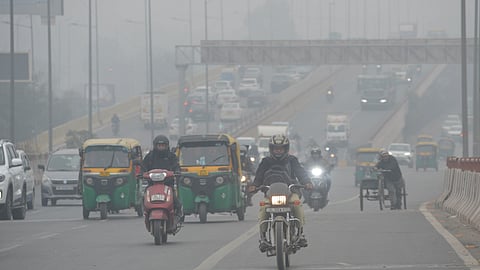

NEW DELHI: More than one lakh vehicle owners applied for Pollution Under Control (PUC) certificates over the past three days as the Delhi government intensified enforcement against polluting vehicles across the capital, Delhi Transport and Health Minister Pankaj Kumar Singh said on Saturday.
Addressing a press conference, Singh said transport-related emissions contribute nearly 20–25 per cent of Delhi’s overall air pollution, and the BJP-led government is working on long-term, data-driven strategies to address the problem.
He said that in last three days, a large number of people came forward to obtain PUC certificates. Highlighting public response to the enforcement drive, Singh noted that over 40,000 vehicles registered for PUC certificates on December 19 alone.
Officials from the Delhi Pollution Control Committee along with police personnel, have been deployed at petrol pumps to monitor compliance. Cameras are also being used to identify vehicles without valid PUC certificates. First-time violators are being issued warnings, while repeat offenders are facing challans. Ambulances and other essential service vehicles have been exempted from penalties, Singh said.
According to official data, enforcement teams issued 1,728 challans on December 17, around 300 on December 18, and nearly 700 on December 19. Vehicles classified as end-of-life, in line with Supreme Court directions, are being turned back at checkpoints.

Singh accused the previous AAP government of failing to achieve meaningful results in controlling pollution, claiming that poor policy implementation over the past decade led to worsening air quality. He said the current government is taking concrete action to reverse the trend. Highlighting progress in electric mobility, Singh said EV registrations in Delhi have crossed the one-lakh mark since the BJP government assumed office in February. He alleged that the earlier government failed to disburse nearly Rs 45 crore allocated for EV subsidies.
On public transport, the minister said 3,518 buses have been added to Delhi’s fleet since February. The number is expected to rise to 5,000 by March and exceed 7,000 by November 2026. He added that advisories have been issued to ensure adequate care for respiratory patients and the availability of medicines.