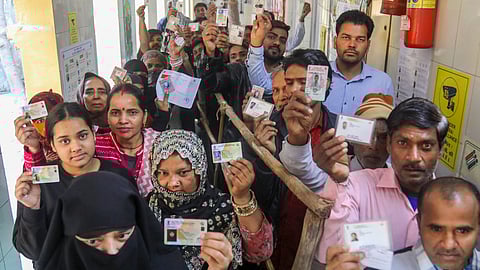

NEW DELHI: The upcoming Special Intensive Revision (SIR) of Delhi’s electoral roll is transforming into a sweeping verification exercise that will compel millions of city residents to prove their citizenship and local residency to retain their right to vote.
As per officials involved in the planning, the exercise will put nearly 68 lakh voters under the scanner, effectively testing their eligibility to remain on the electoral rolls. As reported by TNIE on Sunday, July 6, the Election Commission of India (ECI) has notified March 2008 as the cut-off date for the revision, aligning Delhi's process with a similar and controversial effort already underway in Bihar.
Delhi had 1.06 crore registered voters in 2008, a number that has surged to 1.56 crore in the latest electoral roll published in January this year. Over the past 17 years, officials say around 18 lakh voters have either died or migrated. A roughly equal number has been added in successive revisions, bringing the net number of new or altered entries close to 68 lakh. The figure is over 40 per cent of the current electors.
“We omit at least a lakh names every year from the rolls due to death or migration. If we consider the difference in the voter count between 2008 and now, it conservatively adds up to 70 lakh individuals whose credentials need review," said a senior poll official.
NRC dressed up as voter roll revision?
Under the new procedure, individuals not listed in the 2008 roll will receive enumeration forms requiring them to submit detailed documentation to their respective Electoral Registration Officers (EROs). Failure to furnish the required proof may result in these individuals being flagged as suspected foreign nationals, a clause that has drawn strong comparisons with the National Register of Citizens (NRC) process.
According to the Election Commission’s order dated June 24, the decision to mark a voter as a suspected foreign national lies with the discretion of the ERO or Assistant ERO. The order, however, does not specify any standardised method for making such a determination.
"In case ERO/AERO doubts the eligibility of the proposed Elector (due to non-submission of requisite documents or otherwise), he/she will start a suo moto inquiry and issue notice to such proposed Elector, as to why his/her should not be deleted. Based on field inquiry, documentation or otherwise, ERO/AERO shall decide on inclusion of such proposed Electors in the Final Rolls. In each such case, ERO/AERO shall pass a speaking order. Also, EROS will refer cases of suspected foreign nationals to the competent authority under the Citizenship Act, 1955," the order copy accessed by this newspaper read.
This discretionary power has unsettled many officials. A senior government officer, speaking on condition of anonymity, raised concerns over the fundamental premise of the exercise. “How can someone be branded a suspected foreign national merely because they fail to produce documents? This goes beyond voter correction. It resembles NRC, just under a different name,” the official remarked.
Sources confirmed that the directive issued for Bihar’s SIR will now serve as the framework for Delhi’s revision. However, unlike Bihar, where the timeline is restricted to two months, Delhi may get up to four or five months for the completion of the exercise.
“Training for EROs and BLOs is underway and should conclude by July 17. We expect to begin soon after, but since there’s no election immediately due in Delhi, we may get additional time to complete the process,” said another poll official.