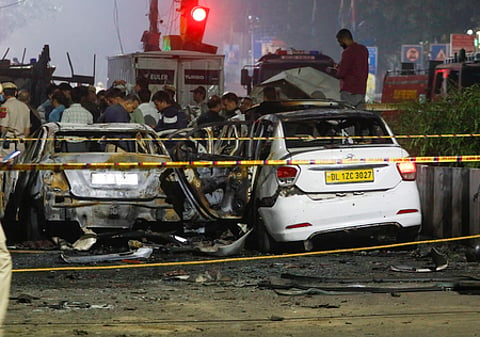

A day after the blast near Delhi’s Red Fort, sources have suggested the possible involvement of Jaish-e-Mohammed (JeM) and its affiliates from Jammu and Kashmir.
According to security sources, the Jammu and Kashmir Police recovered an internal letter from the module during a counter-terror operation in Nowgam.
Sources said the letter, dated October 17, 2025, appeared to have been issued in the name of the banned Pakistan-based terror outfit and was addressed to an unnamed recipient believed to be located either in Pakistan or in Jammu and Kashmir. The language used in the directives was consistent with previous JeM communications circulated between 2016 and 2021.
A source said, “The letter contains jihadist slogans, threats, and warnings of action and punishment against individuals accused of betraying the organisation or cooperating with security forces.”
Invoking the name of a commander identified only as “Ameera-Commander,” the letter concluded with aggressive religious sign-offs typical of JeM’s internal propaganda style, the source added.
According to intelligence officials, an internal fissure within the JeM network may have led to Monday’s Delhi blast. “The tone and timing of this communication suggest growing pressure within the organisation following intensified counter-insurgency operations in Jammu and Kashmir,” a senior intelligence official said.
In the last 14–15 hours since the blast, it has gradually been confirmed as a terror-linked explosion. The incident is being jointly probed by the Delhi Police and central intelligence agencies. Investigators believe that the Nowgam letter may be a critical piece of evidence in establishing both the motivation behind the attack and the internal turmoil within the Jaish-e-Mohammed (JeM).
Given the blast’s links to Jammu and Kashmir—particularly because the last registered owner of the i20 car used in the Delhi blast is from Pulwama—a high-level meeting chaired by Home Minister Amit Shah was convened, in which the Director General of the Jammu and Kashmir Police was also invited to participate.
Investigative agencies have uncovered a chain of evidence connecting the blast to a larger cross-border conspiracy allegedly led by wanted terrorist Maulana Masood Azhar.
Security agencies have placed all prominent locations on high alert, and anti-terror units of police forces across the country are conducting raids and searches.
Investigators have stated that the explosives were placed inside a white Hyundai i20 car, which was detonated near the Sunehri Masjid parking area adjacent to the Red Fort complex.
The probe agency is investigating whether the blast was part of a planned fidayeen (suicide) attack, suspected to have been carried out by Dr. Umar Mohammad, a trained Jaish-e-Mohammed (JeM) operative and a key member of the Faridabad terror module, or whether he was transporting the car to another location to carry out a strike but panicked upon seeing a police post near the traffic light.
DNA tests of the two charred, unidentified bodies are still underway.
Following the blast, police recovered two unidentified bodies from the scene. One body was found inside the charred remains of the i20 vehicle and is believed to be that of the suicide bomber.
Police said that the pattern of the blast—the intensity and manner of the explosion—suggests it was a planned fidayeen attack.
However, this remains a part of the ongoing investigation. The explosion occurred just minutes after the car left the parking zone, indicating that the detonation may have been triggered prematurely.
Intelligence officials stated that the blast was preceded by a series of coordinated raids conducted by the anti-terror units of the Delhi, Haryana, and Jammu & Kashmir police forces in Faridabad. These raids, carried out on Sunday, reportedly triggered panic among JeM members.
The members were already under surveillance for alleged terror financing and recruitment activities in the Valley.
It is believed that, in a desperate attempt to evade the police, the suspect Dr. Umar Mohammad, along with two other members, fled in a white Hyundai i20 from Faridabad, crossed the Badarpur border, and entered Delhi.
It remains under investigation whether the explosives being carried were intended for a larger fidayeen mission in the national capital.
