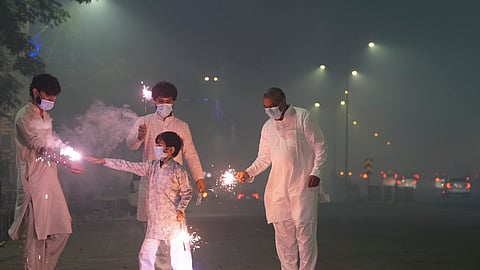

Firecrackers emerged as the biggest contributor to Delhi's air pollution on both Monday and Tuesday, accounting for 71.1 per cent and 29.8 per cent of the pollution load, respectively, according to source-apportionment estimates by the Indian Institute of Tropical Meteorology (IITM).
The contribution of firecrackers to the city's pollution levels was significantly higher on Monday, a day after Diwali, before declining on Tuesday, the IITM models showed.
The estimates had a standard deviation (SD) of 104.1 percentage points on Monday and 27.7 percentage points on Tuesday, indicating considerable variability and uncertainty in the modelled contributions.
On Monday, vehicular emissions accounted for 6.9 per cent of the pollution, followed by secondary inorganic aerosols at 5 per cent and secondary organic aerosols at 4.5 per cent. Mixed or unresolved biofuel contributed 4.4 per cent, while mineral dust and ash and mixed combustion accounted for 2.5 per cent each.
Wood burning contributed 1.3 per cent, while waste burning, including municipal and plastic-rubber containing waste, accounted for 1.1 per cent. Coal combustion and industrial emissions contributed 0.5 per cent and 0.2 per cent, respectively.
On Tuesday, the contribution of firecrackers dropped to 29.8 per cent, while secondary organic aerosols emerged as the second-largest contributor at 17.5 per cent.
Vehicular emissions and secondary inorganic aerosols each accounted for 11.7 per cent of the pollution load, while wood burning contributed 10.7 per cent and waste burning 7.7 per cent.
Vehicular emissions emerged as the third largest contributor to pollution on Tuesday.
Mixed combustion accounted for 5.1 per cent, followed by mixed or unresolved biofuel at 3.3 per cent and mineral dust and ash at 1.5 per cent.
Delhi's average 24-hour Air Quality Index (AQI) had improved marginally to the 'poor' category on Tuesday, with the 4 pm reading settling at 299.
However, air quality deteriorated again on Wednesday, with the AQI climbing to 312, placing it in the 'very poor' category.
An AQI between 201 and 300 is classified as 'poor', while readings between 301 and 400 fall in the 'very poor' category.
The IITM estimates indicate that while the contribution of firecrackers declined after Diwali, they continued to remain the single largest identified source of pollution on Tuesday.
(With inputs from PTI)
