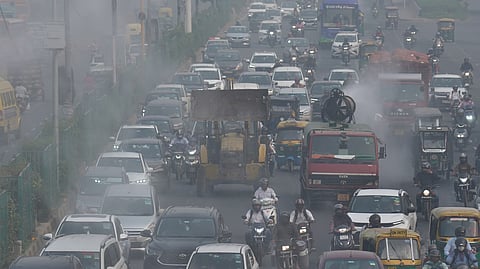

Delhi's air quality showed some improvement by Friday evening, with the Air Quality Index (AQI) dropping to 373 at 4 pm from above 400 in the morning. However, the air quality remained in the 'very poor' category as a thick blanket of smog continued to envelop the national capital, reducing visibility and triggering complaints of breathing difficulties among residents.
The city's AQI had entered the 'severe' category in the morning, with the pollution level touching upto 488 before declining through the day. Despite the improvement, 16 of the 59 monitoring stations that recorded data were still in the 'severe' category at 4 pm.
The city witnessed hazy conditions throughout the day, with buildings and the skyline obscured by dense grey smog. The sun appeared as a faint disc, while unfavourable weather conditions and weak winds prevented pollutants from dispersing.
Several residents took to social media to report throat irritation, persistent coughing, chest discomfort and breathlessness. Some also complained of respiratory discomfort even while indoors.
Of the 59 monitoring stations that recorded data at 4 pm, 16 reported 'severe' air quality, while most of the remaining stations recorded 'very poor' levels. Delhi Cantonment was the only station to register 'moderate' air quality.
IIT-Delhi recorded the highest AQI at 452, followed by North Campus (Delhi University) at 446, Narela and Pusa at 437 each, and Punjabi Bagh at 431.
Earlier in the morning, the city's air quality had deteriorated to the 'severe' category for the first time this season. The instantaneous AQI touched 403 at 6.05 am and remained at the same level at 8 am and 9 am, according to the Central Pollution Control Board's (CPCB) Sameer app.
At 8 am, 33 of the 58 monitoring stations that recorded data reported 'severe' air quality, while 24 were in the 'very poor' category and one recorded 'moderate' levels.
IIT-Delhi recorded the worst AQI at 488, followed by Chandni Chowk at 479 and North Campus at 478. Burari Crossing registered 456, while ITO and Jawaharlal Nehru University recorded 451 each.
According to the Decision Support System (DSS), transport was the largest contributor to Delhi's pollution at 18.5 per cent. Residential sources accounted for 4.6 per cent, followed by peripheral industries (3.7 per cent), construction (2.5 per cent), road dust (1.3 per cent) and other sectors (1.2 per cent).
Among the neighbouring National Capital Region (NCR) districts, Jhajjar in Haryana contributed the highest share at 7.2 per cent, followed by Gurugram (5.4 per cent), Gautam Buddh Nagar (4.8 per cent), Bulandshahr (4.4 per cent), Faridabad (3.3 per cent), Ghaziabad (3.1 per cent), Bhiwani (2.2 per cent), Rohtak (1.9 per cent), Alwar (1.8 per cent) and Sonipat (1.2 per cent). Other districts together accounted for 18.1 per cent.
The Air Quality Early Warning System has forecast that Delhi's AQI is likely to remain in the 'very poor' category from Saturday until November 16. The outlook for the following six days also indicates similar conditions.
The ventilation index is expected to remain below 6,000 square metres per second, while average wind speeds are likely to stay below 10 kmph, conditions that are unfavourable for the dispersal of pollutants.
The CPCB classifies AQI levels of 0-50 as 'good', 51-100 as 'satisfactory', 101-200 as 'moderate', 201-300 as 'poor', 301-400 as 'very poor' and 401-500 as 'severe'.
(With inputs from PTI)
