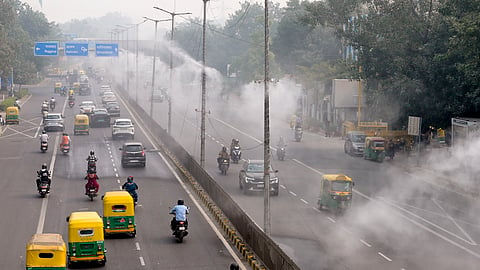

The transport sector is expected to remain the largest contributor to Delhi's pollution over the next few days, while the contribution of stubble burning is likely to remain relatively low, according to a revised forecast released on Thursday afternoon.
According to the Decision Support System (DSS) for Delhi, transport emissions are expected to account for around 16 per cent of the city's pollution load on Thursday, while stubble burning is estimated to contribute 8.9 per cent.
The transport sector's contribution is projected to rise to 18.5 per cent on Friday, while the share of stubble burning is expected to decline further to 5.3 per cent. On Saturday, transport emissions are likely to account for 20.5 per cent of the pollution load, while stubble burning's contribution is forecast at 13.29 per cent.
The revised forecast marks a departure from Wednesday's projections, which had indicated a sharp increase in the contribution of stubble burning to Delhi's pollution, with its share expected to reach around 20 per cent on Thursday.
Meanwhile, secondary organic aerosols emerged as the biggest contributor to Delhi's pollution on Wednesday, accounting for 22.7 per cent of the pollution load, closely followed by domestic solid biofuel burning at 22.3 per cent, according to source-apportionment estimates by the Indian Institute of Tropical Meteorology (IITM).
Vehicular emissions accounted for 19.3 per cent of the pollution, while secondary inorganic aerosols contributed 11.9 per cent, IITM models showed.
Experts said secondary organic aerosols originate from several sources, including certain industries, diesel and petrol vehicles, and biomass burning.
The contribution of firecrackers, which had emerged as the biggest source of pollution on Monday and Tuesday following Diwali, dropped sharply to 7.4 per cent on Wednesday.
Firecrackers accounted for 71.1 per cent of Delhi's pollution load on Monday, with their contribution declining to 29.8 per cent on Tuesday.
The estimates showed that mixed combustion accounted for 10.6 per cent of the pollution load on Wednesday, followed by waste burning, including municipal and plastic- and rubber-containing waste, at 2.1 per cent.
Wood burning contributed 1.2 per cent, while industrial emissions and mineral dust and ash accounted for 1 per cent and 0.9 per cent, respectively. Coal combustion contributed 0.7 per cent.
Delhi's average 24-hour Air Quality Index (AQI) deteriorated to 313 on Wednesday and stood at 342 at 3 pm on Thursday, placing it in the 'very poor' category. The air quality had improved marginally to the 'poor' category on Tuesday, with the 4 pm reading at 299.
An AQI between 201 and 300 is classified as 'poor', while readings between 301 and 400 fall in the 'very poor' category.
(With inputs from PTI)
