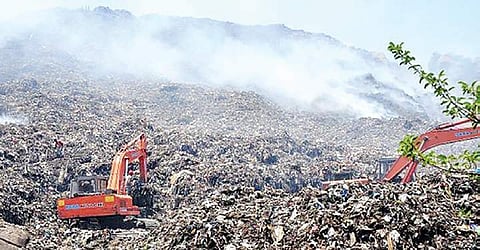

HYDERABAD: A landmark environmental order meant to heal Hyderabad’s poisoned landfill has triggered an unexpected civic crisis. A week after the National Green Tribunal (NGT) banned fresh dumping at the Jawaharnagar landfill, garbage collection across the city has slowed to a crawl, leaving neighbourhoods buried under growing heaps of uncollected waste.
The NGT, in its recent directive, ordered the Greater Hyderabad Municipal Corporation (GHMC) to stop sending new waste to Jawaharnagar, allowing only the processing of the massive piles already lying there. The tribunal stressed that no fresh municipal or refuse-derived fuel (RDF) waste should enter the site and urged the GHMC to act quickly to reduce its environmental impact.
However, the sudden enforcement of the order has thrown GHMC’s waste management system into disarray. With Hyderabad generating nearly 10,000 tonnes of garbage daily, and Jawaharnagar handling almost all of it, the city now has nowhere to send its waste.
“Since the NGT order, vehicles have nowhere to unload. Transfer stations are full,” a civic official told TNIE. “The Vattinagulapally station can handle only 50 tonnes a day — barely a fraction of what’s needed. We are running out of space.”

Residents across several localities say garbage has not been cleared for three to four days, raising fears of disease and a spike in stray dog numbers. “Our bins are overflowing and the smell is unbearable,” said Sudhir Ramesh, a resident of Narsingi. “We are told to segregate waste at home, but what’s the use if GHMC can’t collect it?”
Officials admit that smaller composting units in areas like Manikonda, Miyapur and Narsingi remain underused. “There’s land that could have been turned into composting yards, but it’s lying idle,” said a municipal employee. “If decentralised facilities existed, this situation wouldn’t have arisen.”
Civic activists blame years of overdependence on Jawaharnagar. “Hyderabad needs multiple waste processing units in each zone,” said civic activist Vinay. “Without decentralisation and source segregation, the system will collapse every time one major site shuts down.”